

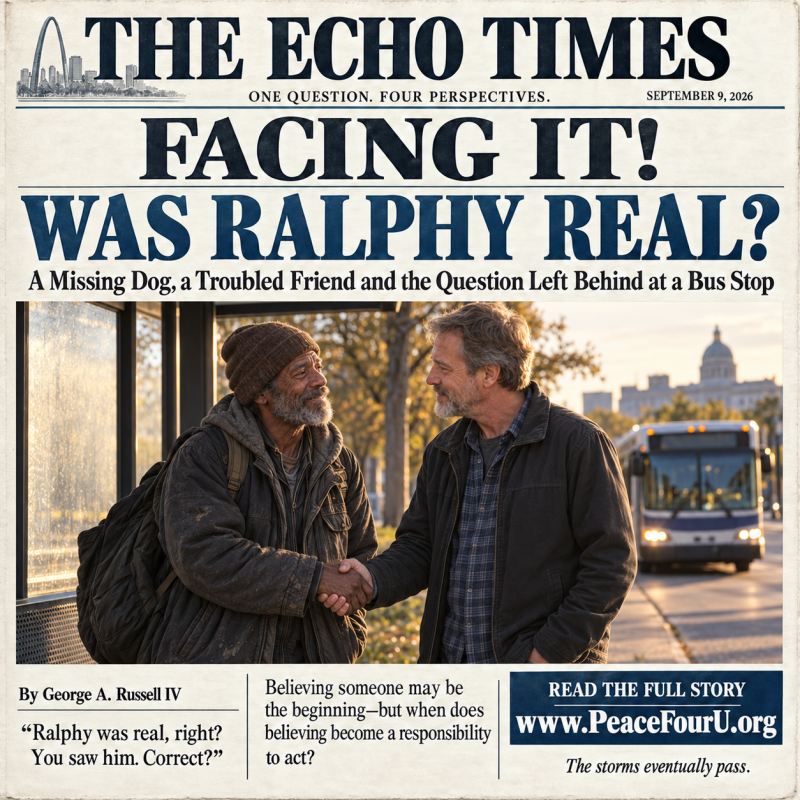
Facing IT!
Was Ralphy REAL?
By Bert Russell
I saw Lawrence yesterday at the bus stop.
He was alone.
Not seeing Ralphy was the first thing I noticed, but I decided it was best not to ask about him. I would let Lawrence tell me when he was ready.
“Hey, Lawrence. What’s up, brother?”
I reached out my hand as I had done many times before. Somehow, our hands did not connect correctly. Instead of gripping my hand, he caught several of my fingers and crushed them together.
Boy, I hate those kinds of handshakes.
I do not know whether he missed my hand or I missed his, but my fingers took the full brunt of that awkward, painful grip.
“Ouch!”
Then I asked him how his holiday weekend had been.
Lawrence seemed to cower slightly before telling me that Ralphy had been arrested.
For a moment, I wondered whether he was talking about his friend Ralph—or the dog.
He said he and Ralphy had gone to the Blue River Trail and had a blast. On their way back, they decided to cut through a neighborhood. Ralphy spotted a squirrel and took off running.
Lawrence had not thought much about it at first. Ralphy was an active puppy. The Labrador in him must have been a strong trait because he loved the water and enjoyed chasing sticks.
The squirrel was something new.
They had struggled to find food that morning, Lawrence explained. Maybe Ralphy was simply hungry.
Then Lawrence stopped talking.
For a few seconds, it seemed as though he had heard or seen something inside his own mind. He stood perfectly still, perhaps visualizing what had happened—or replaying the memory and trying to understand it.
Then he turned toward me.
“Ralphy was real, right? You saw him. Correct?”
That question was my first sign that something bad might have happened.
For Christ’s sake, Lawrence lived on the streets. How many people truly listened to him? How many dismissed him before he could finish telling his story?
“No one believes me,” he said. “I told everyone at the soup kitchen. They said Ralphy died. They told me to get over it, quit making up stories and get on with my life.”
“Yes, Lawrence,” I told him. “Ralphy was real. I saw him. Your friends just didn’t get the chance to meet him in that form.”
Then I returned to what he had told me earlier.
“You said Ralphy got arrested. What are you talking about?”
I was becoming seriously concerned.
Lawrence said a man in a uniform had grabbed Ralphy around the neck and put him inside a police-type van. The vehicle had flashing lights—sirens and strobes, as Lawrence described them.
It took me a moment to understand.
He was talking about an animal-control officer.
Lawrence was worried that Ralphy might be on death row if he could not provide an address—and provide one quickly.
Was Lawrence asking me to help him find Ralphy?
Was he asking me to give them an address?
Or did he simply need one person to believe that his friend was real?
Before I could understand exactly what he needed from me, the bus arrived.
We said our goodbyes.
Then Lawrence hugged me.
The embrace startled me, but I embraced him in return. He was incredibly strong, although the reality of living on the streets clung heavily to his clothes.
Then the doors closed, and he was gone.
I stood there wondering whether I had answered the right question.
I had told Lawrence that Ralphy was real—but had I done enough to help him?
Sometimes people do not know how to ask directly for what they need. Their request comes through a story, a pause, a frightened expression or an unexpected hug.
The difficult part is recognizing the question before the bus arrives.
Was Lawrence asking me to find Ralphy—or was he asking for something deeper?
Maybe he simply needed one person to look him in the eyes and say:
“Yes, Lawrence. Ralphy was real. I saw him, too.”
But now I am left facing another question:
Believing someone is the beginning—but when does believing become a responsibility to act?
Facing IT!
The storms eventually pass. ✌️
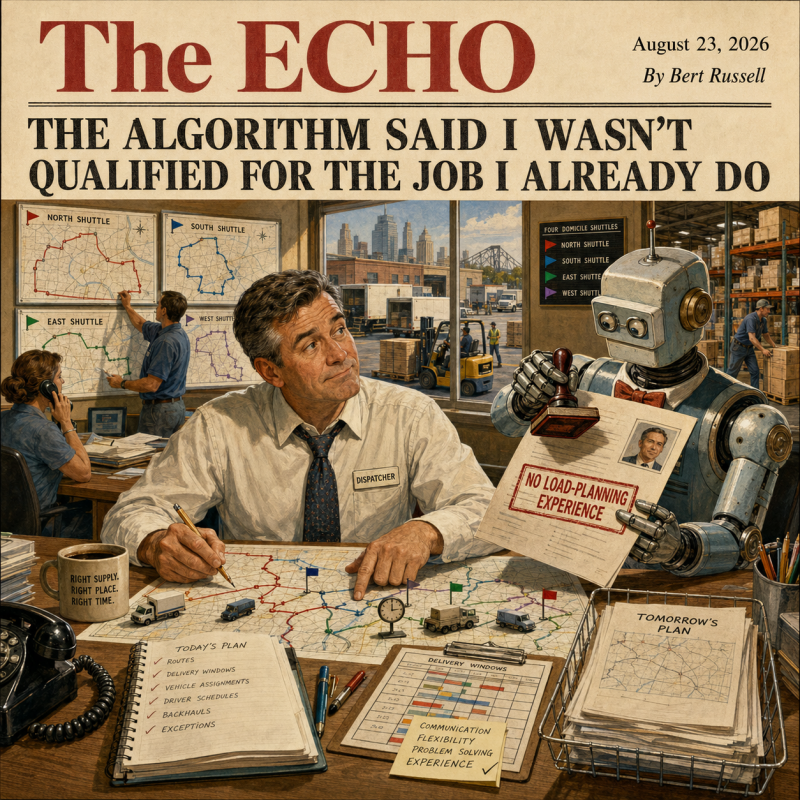
FACING IT!
THE ALGORITHM SAID I WASN’T QUALIFIED FOR THE JOB I ALREADY DO
Artificial intelligence can process millions of words—but apparently it still cannot read between the lines.
I recently asked LinkedIn’s artificial-intelligence software whether I was qualified for a Transportation Load and Capacity Planner position.
It said no.
According to the software, I did not have load-planning or supply-chain experience.
That answer blew my mind.
I currently coordinate the movement of all routed orders through Medline’s Kansas City distribution branch. Approximately 95 percent of my job involves planning and optimizing routes using transportation-routing technology.
I work inside a supply-chain distribution center.
I coordinate drivers, delivery windows, equipment, freight movement and four domicile shuttles. I monitor service performance, overtime, fuel efficiency and other operational measurements.
That sounds a lot like transportation load and capacity planning to me.
The problem appears to be my job title.
My official title is Dispatcher.
I do not know why.
I am not really a dispatcher—not in the traditional sense of someone spending the day talking to drivers and reacting to problems.
My dispatching responsibility largely consists of pressing a button and sending a notification.
My real job is route planning.
I optimize for a living.
I study where orders are located, how they should be grouped, which vehicles should carry them and how drivers can complete their routes within the required service windows.
I also use something machines sometimes overlook: public knowledge.
Census information, demographic data, road networks, geography and local knowledge are available to anyone willing to study them. I combine that information with routing technology and practical experience to build better routes.
That is planning.
That is optimization.
That is supply-chain work.
But LinkedIn’s AI apparently searched my profile for specific words. It saw “Dispatcher” instead of “Load Planner.” It did not see enough references to “supply chain,” so it concluded that I lacked the experience.
The machine understood the label but missed the work.
That exposes one of the biggest problems with artificial intelligence.
If I listed every responsibility, lesson, system and experience from my working life, my résumé could easily exceed 25 pages. Nobody wants to read a résumé that long. Applicants are told to keep everything concise.
Then an algorithm penalizes us because we did not include every possible keyword.
Which instruction are we supposed to follow?
Keep it short?
Explain everything?
Use natural language?
Copy the exact language from the job advertisement?
Companies spend enormous amounts of money developing, purchasing and implementing hiring technology. Yet a system can still look at someone who performs a job every day and decide that he is not qualified to perform it.
That should concern employers as much as applicants.
How many qualified people never apply because an AI assistant tells them they are not a good match?
How many employers miss experienced candidates because the candidate’s official job title does not accurately describe the work?
How many people know how to manipulate keywords better than they know how to perform the job?
AI can be useful. I use it regularly, and I believe it can help people organize thoughts, recognize patterns and communicate more effectively.
But AI is only as intelligent as the information it receives—and the assumptions built into it.
My experience did not suddenly become valid after I added the phrases “load planning” and “supply-chain operations” to my profile.
Those words merely helped the machine recognize what I had already been doing.
Maybe that is the lesson.
Artificial intelligence can evaluate the words on a résumé.
It cannot always evaluate the person behind them.
The storms eventually pass. Or does it? ✌️
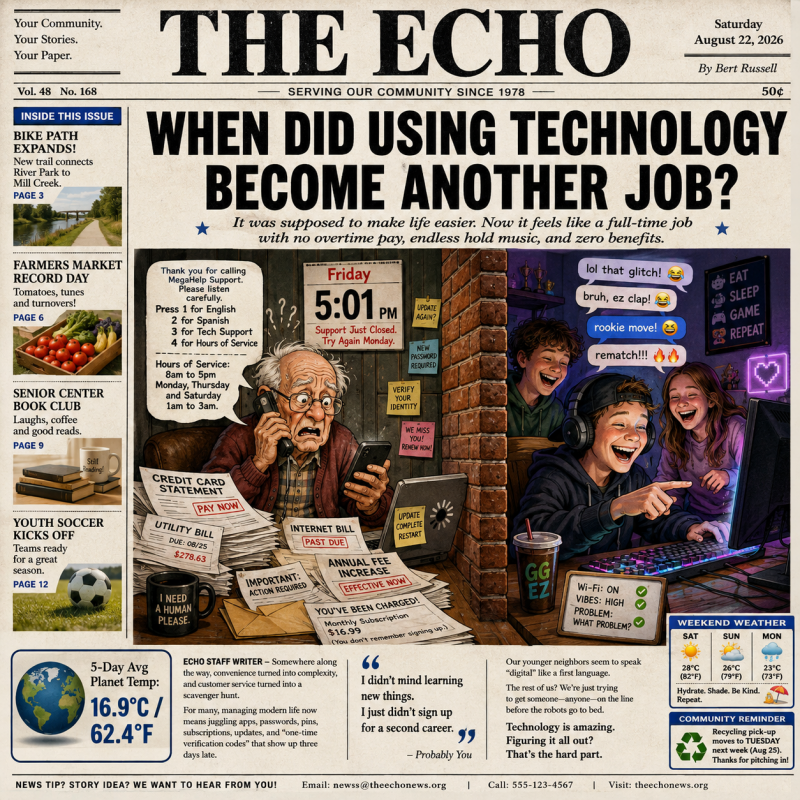
FACING IT!
WHEN DID USING TECHNOLOGY BECOME ANOTHER JOB?
It was supposed to make life easier. So why does it feel like I need a full-time security team just to use my phone?
There was a time when the word free actually meant something.
Free meant free.
No trial period.
No hidden charge.
No “cancel within three days or we start billing you $14.99 a week.”
No tiny print designed to be read by a lawyer, a microscope, or somebody with unlimited patience.
If something was free, you used it.
If you liked it, great.
If you didn’t, you moved on.
That was it.
Now everything feels like a trap.
I recently went looking for something simple: a program that could take written words and turn them into spoken audio.
I wasn’t trying to launch a radio station.
I wasn’t producing an audiobook.
I just wanted to paste in something I had written and hear it read aloud.
Simple enough, right?
Apparently not.
You search for a free application.
The website says FREE.
You download it.
Then you find out the free version only allows a small amount of text.
Or only one voice.
Or it disables the feature you actually wanted.
Or suddenly there is a free trial attached to a credit card.
And somewhere buried in the agreement is the part that says the “free” application is going to start charging you automatically.
Sometimes monthly.
Sometimes weekly.
Weekly.
Who decided weekly subscriptions were a good idea?
When did we reach the point where downloading a simple application requires the same level of attention as signing a contract?
Technology was supposed to make life easier.
That was the bargain.
Computers were going to save time.
Phones were going to simplify communication.
Applications were going to organize our lives.
The internet was going to give us information instantly.
Instead, some days it feels like using technology has become another job.
You have to monitor subscriptions.
Monitor free trials.
Monitor passwords.
Monitor privacy settings.
Monitor bank accounts.
Monitor credit cards.
Monitor text messages.
Monitor emails.
Monitor links.
Monitor pop-ups.
Monitor downloads.
Monitor updates.
Monitor whether the person contacting you is actually who they claim to be.
Monitor whether the application you just downloaded installed something else you never asked for.
And monitor whether something advertised as free is actually free.
That is work.
Real mental work.
The strange thing is that many consumers aren’t opposed to paying for something useful.
I’m not.
If you build a good product, tell me what it costs.
If it is $4.99 a month, say $4.99 a month.
If it is $49.99 a year, say $49.99 a year.
Then I can decide whether the service is worth the money.
What irritates me is the game.
FREE!
Then underneath:
Free for three days.
Free with limited features.
Free if you provide a credit card.
Free until you forget to cancel.
Free unless you actually want to use the feature advertised on the front page.
That isn’t really free.
That is marketing.
And maybe the bigger problem is what all this does to trust.
We already live in a world filled with scams.
Fake texts.
Fake job offers.
Fake bank warnings.
Fake delivery notices.
Fake refunds.
Fake websites.
Fake customer service numbers.
Fake investment opportunities.
Now legitimate companies sometimes use marketing techniques that make people suspicious too.
That creates a dangerous environment.
When everything looks like a trick, eventually people stop trusting anything.
And I think older adults especially feel that pressure.
Technology changes quickly.
Buttons move.
Applications update.
Passwords expire.
Websites redesign themselves.
New scams appear constantly.
One wrong tap can feel frightening.
Then we tell people they should have known better.
But how much knowledge are we expecting the average person to carry around just to participate in modern life?
You almost need to become your own accountant, security officer, computer technician, fraud investigator and subscription manager.
Parents have an even harder job.
They aren’t only managing their own digital lives.
They are trying to protect their children too.
What are the kids downloading?
What are they buying?
What are they watching?
Who are they talking to?
Which game is actually free?
Which application has in-app purchases?
Which advertisement is legitimate?
Which link is dangerous?
Which company now has access to their location, camera, microphone or personal information?
That is a tremendous amount of responsibility.
And maybe that is the question we should be asking.
If technology was invented to make life easier, why does protecting ourselves from technology require so much work?
Maybe companies need to rediscover something very simple:
Clarity builds trust.
Tell people the price.
Tell people when they will be charged.
Make cancellation easy.
Don’t hide the important information in tiny print.
Don’t call something free when the real goal is to get a credit card number and hope the customer forgets to cancel.
Technology doesn’t have to be free.
It just needs to be honest.
Because somewhere along the way, convenience became something else.
It became something we have to manage.
Something we have to monitor.
Something we have to protect ourselves from.
And that leaves me with one question:
When did using technology become another job?
Peace of MIND, BODY, and SOUL! ✌️
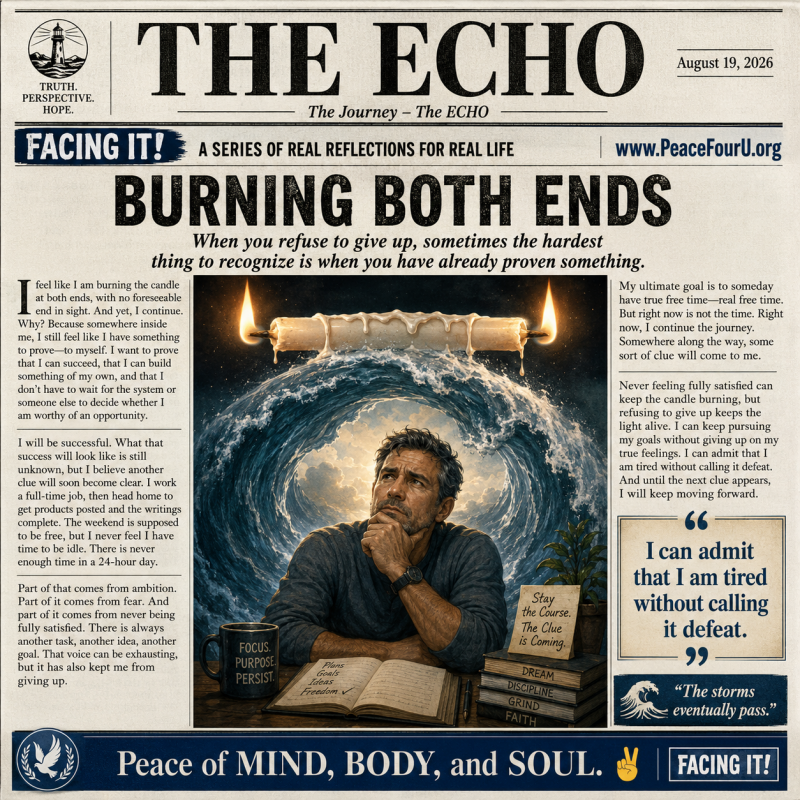
FACING IT!
BURNING BOTH ENDS
When you refuse to give up, sometimes the hardest thing to recognize is when you have already proven something.
August 19, 2026
www.PeaceFourU.org
I feel like I am burning the candle at both ends, with no foreseeable end in sight.
And yet, I continue.
Why?
Because somewhere inside me, I still feel like I have something to prove.
Not necessarily to everyone else.
To myself.
I want to prove that I can succeed. That I can build something of my own. That I don't have to wait for "the man," the system, or somebody else to decide whether I am worthy of an opportunity.
I will be successful.
What exactly will that success look like?
I still don't know.
That's the strange part.
I know I'm chasing something, but I can't completely see it yet. It's almost like following a trail when the next marker hasn't appeared. You know you're moving in the right direction. You just haven't reached the next clue.
So I keep moving.
I work my full-time job.
Then I come home and start working again.
Products need to be photographed, listed, described, and posted.
Articles need to be written.
Ideas need to become something real.
Websites need attention.
Then the weekend arrives—the time that is supposedly meant for rest—and somehow I still can't convince myself that it's okay to be idle.
There never seems to be enough time in a 24-hour day.
Maybe part of that comes from ambition.
Maybe part of it comes from fear.
And maybe part of it comes from never being completely satisfied.
There is always another mountain.
Another idea.
Another goal.
Another voice inside saying:
You aren't finished yet.
That voice can be exhausting.
But that same voice has also kept me from giving up.
That's the conflict I'm Facing IT! with.
There is a thin line between refusing to quit and refusing to allow yourself to rest.
I dream about reaching a point someday when I have free time—real free time. The kind where I can sit somewhere without thinking about what I should be doing next.
But right now, I don't feel like I am there.
Right now, I am still building.
Still experimenting.
Still searching.
Still failing sometimes.
Still learning.
Still getting back up.
And somewhere along this journey, I believe another clue will appear.
Maybe success isn't one giant revelation.
Maybe it arrives as small clues scattered along the road.
A product sells.
Someone reads something I wrote.
An idea connects.
A door unexpectedly opens.
Something that once seemed impossible becomes routine.
And eventually, when you look backward, you realize those little clues were leading somewhere the entire time.
I may never be completely satisfied.
Maybe that's part of what keeps me moving.
But I also have to remember that being unsatisfied with where I am does not mean I should be ungrateful for how far I've traveled.
There is a difference.
I can want more without pretending that what I've already accomplished means nothing.
I can keep pursuing my goals without giving up on my true feelings.
And I can admit that I am tired without interpreting tiredness as defeat.
So, for now, I keep going.
Not because I know exactly where this road ends.
But because something inside me still believes there is another clue ahead.
And when it appears...
I'll be there to see it.
Never feeling completely satisfied can keep the candle burning.
Just don't forget that even the person carrying the flame deserves to see how much darkness they've already pushed away.
I continue my baby steps! Will you?
Peace of MIND, BODY, and SOUL. ✌️
Facing IT!
The storms eventually pass.
THE ECHO
FACING IT!
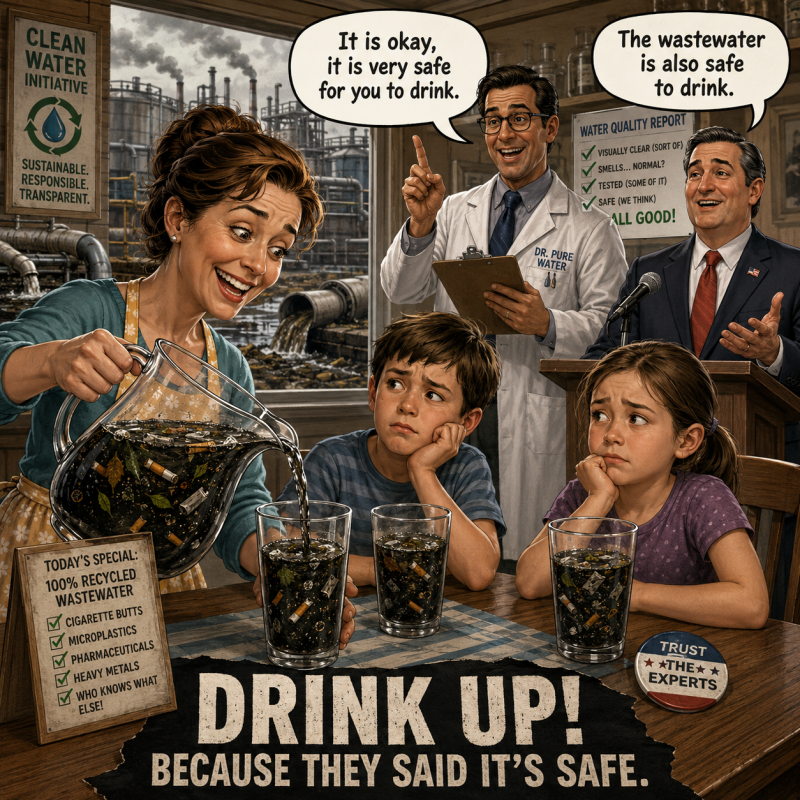
THEY SAID IT WAS SAFE
Would You Drink Wastewater If Scientists Said It Was Safe?
Imagine someone hands you a cold, crystal-clear glass of water.
It looks clean.
It smells clean.
Then they tell you:
Yesterday, part of this water was wastewater.
It has been filtered, disinfected, purified and tested. Scientists say it meets drinking-water standards. Government regulators say it is safe.
Would you drink it?
Maybe you would.
Maybe you wouldn't.
But here's the more important question:
Would you investigate before deciding?
We live in a society surrounded by people and organizations telling us what to believe.
Government agencies tell us something is safe.
Corporations tell us their products are better.
Infomercials tell us something is scientifically proven.
Influencers tell us what we need.
Advertisements tell us what will make us happier.
Social media algorithms repeatedly show us things we already tend to believe.
Eventually, repetition can begin to feel like truth.
LOOK AT OUR FOOD
Walk into an American grocery store and pick up a loaf of bread.
It seems simple enough.
Flour. Water. Yeast.
But modern packaged bread can contain additional ingredients and additives designed to improve texture, consistency, appearance or shelf life.
Here's where things become interesting.
Food regulations aren't identical around the world.
Some ingredients or additives permitted in foods sold in the United States have been prohibited or restricted in other countries, while other substances permitted elsewhere face different American rules.
That doesn't automatically mean American bread is dangerous.
And it doesn't automatically mean another country's regulators are right.
It means we should ask questions.
Why is an ingredient considered acceptable here but restricted somewhere else?
What evidence was used?
How much of it are we actually consuming?
What does independent research show?
And when new evidence appears, are the rules reconsidered?
NOW LOOK AT THE WATER
The same reasoning applies to recycled water.
Advanced purification can involve multiple treatment barriers such as filtration, reverse osmosis, ultraviolet treatment and rigorous testing.
Science deserves to be heard.
But science also gives us something more valuable than simply an answer.
It gives us a method for questioning the answer.
Ask for the evidence.
Examine the testing.
Compare independent research.
Understand the risks.
Then make an informed decision.
THE INFOMERCIAL EFFECT
Remember those late-night commercials?
A person struggles terribly with an ordinary kitchen knife.
Then—
BUT WAIT!
For only $19.95, there's a miraculous solution.
There's an expert.
There's a demonstration.
There's a testimonial.
There's a statistic.
There's even a limited-time offer.
Call in the next ten minutes!
The purpose isn't to give you enough time to investigate.
The purpose is to persuade you to act.
Modern persuasion has become considerably more sophisticated, but the principle hasn't changed.
Create urgency.
Establish authority.
Repeat the message.
Show other people accepting it.
Then encourage action.
FACE IT!
The danger isn't that government always lies.
It doesn't.
The danger isn't that corporations always deceive us.
They don't.
And questioning authority doesn't automatically make the person asking the question correct either.
The danger comes when we stop thinking because someone else has already done the thinking for us.
A scientist should be able to explain the evidence.
A government agency should be able to show its standards.
A corporation should be able to support its claims.
An advertisement should survive scrutiny.
And we should be willing to question information that agrees with us just as aggressively as information that doesn't.
Because critical thinking isn't about automatically saying:
“I don't believe you.”
It is having enough curiosity to say:
“SHOW ME WHY I SHOULD.”
THE ECHO QUESTION
If someone you trust tells you something is safe, do you accept the answer—or do you ask how they know?
Education is the key. Teaching is the degree.
www.PeaceFourU.org
FACING IT!
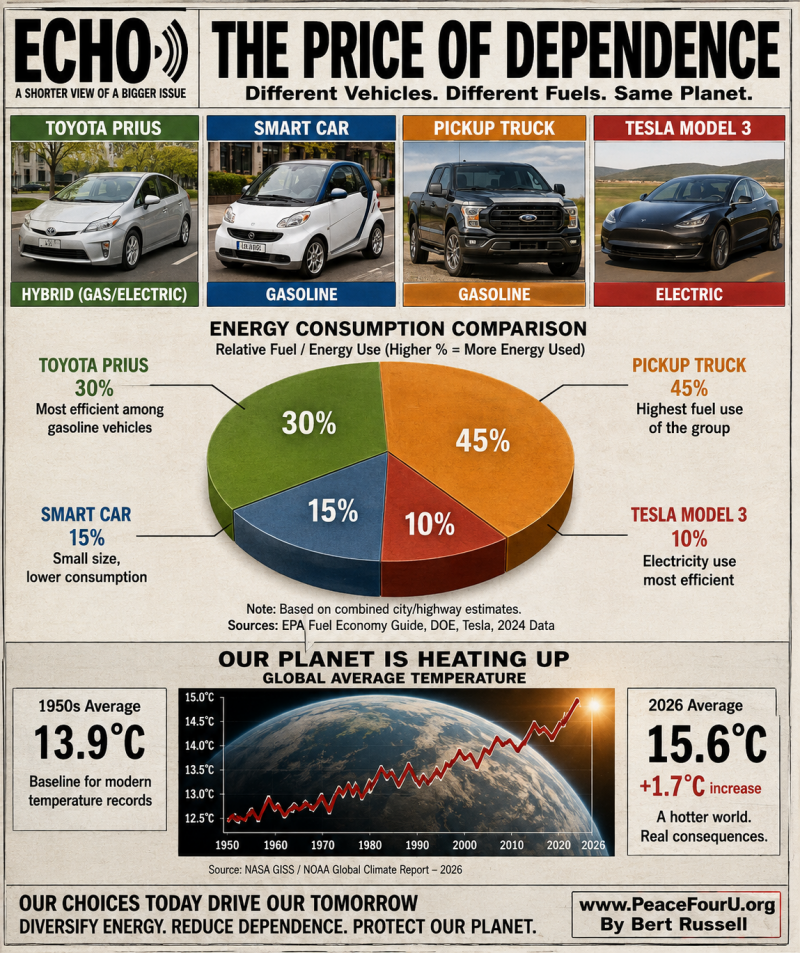
THE PRICE OF DEPENDENCE
Why Should a War Thousands of Miles Away Change the Price at My Gas Pump?
August 13, 2026
www.PeaceFourU.org
You drive past the gas station Monday and see one price.
Tuesday, it changes.
Wednesday, something happens on the other side of the world—and suddenly everyone is talking about what gasoline might cost next week.
Why?
We are told it is supply and demand.
Technically, it is.
But we need to Face IT!
Oil isn't merely a local product. It is a globally traded commodity, and its price reflects not only how much oil exists today, but what buyers and sellers believe might happen tomorrow.
A war begins.
A shipping route is threatened.
A refinery shuts down.
A hurricane approaches.
Political tensions rise.
The physical gasoline in the underground tank at our neighborhood station may not have changed—but the world's expectations have.
And expectations have a price.
OUR DEPENDENCE HAS A COST
For more than a century, petroleum helped build the modern world.
Cars. Trucks. Tractors. Ships. Aircraft. Plastics. Manufacturing. Highways. Global commerce.
Oil gave humanity tremendous mobility.
But dependence has consequences.
When a resource becomes essential to transportation, industry, national security and economic survival, controlling its production and movement becomes extraordinarily important.
That means an international crisis involving an oil-producing region can eventually reach an ordinary American standing beside a gas pump.
That should make us ask a bigger question:
Do we want transportation to remain this dependent on one family of fuels?
ELECTRIC IS PART OF THE ANSWER—NOT THE ENTIRE ANSWER
Electric vehicles are promising.
But replacing hundreds of millions of gasoline-powered vehicles with electric ones is not as simple as changing engines.
We also need electricity generation, transmission, distribution, charging stations, energy storage and a grid capable of supporting greater demand.
So perhaps we shouldn't search for one replacement for gasoline.
We should search for many.
Electricity.
Hydrogen.
Biofuels.
Renewable liquid fuels.
More efficient vehicles.
Better mass transportation where practical.
And technologies we haven't perfected—or perhaps haven't invented—yet.
Individual convenience may occasionally have to compete with what works best for society as a whole.
That will be uncomfortable.
But so is remaining dependent on petroleum forever.
THE ATMOSPHERE DOESN'T CARE ABOUT POLITICS
There is another price we rarely see displayed on the gas-station sign.
Carbon.
Burning gasoline and diesel releases carbon dioxide into the atmosphere.
Carbon dioxide and other greenhouse gases trap heat that would otherwise escape into space.
One automobile doesn't change the planet.
Neither does one truck.
But billions of engines, power plants, factories and other sources operating year after year create something much larger.
That is the greenhouse effect intensified by human emissions.
Transportation therefore isn't simply an economic issue.
It is an environmental one.
And it is a national-security issue.
FACE IT!
Maybe the argument shouldn't be:
Gasoline or electric?
Maybe that question is too small.
The better question may be:
HOW MANY DIFFERENT WAYS CAN WE CREATE TO MOVE PEOPLE AND GOODS WITHOUT DEPENDING SO HEAVILY ON ONE RESOURCE?
We shouldn't wait for another war, another oil shock or another environmental warning before searching for alternatives.
Petroleum helped create the transportation system we have today.
We don't need to erase that history.
We need to learn from it.
Because true energy independence may not mean producing more of one fuel.
It may mean no single fuel has enough power over us to control how we live.
FACE IT!
The storms eventually pass.
www.PeaceFourU.org
FACING IT!
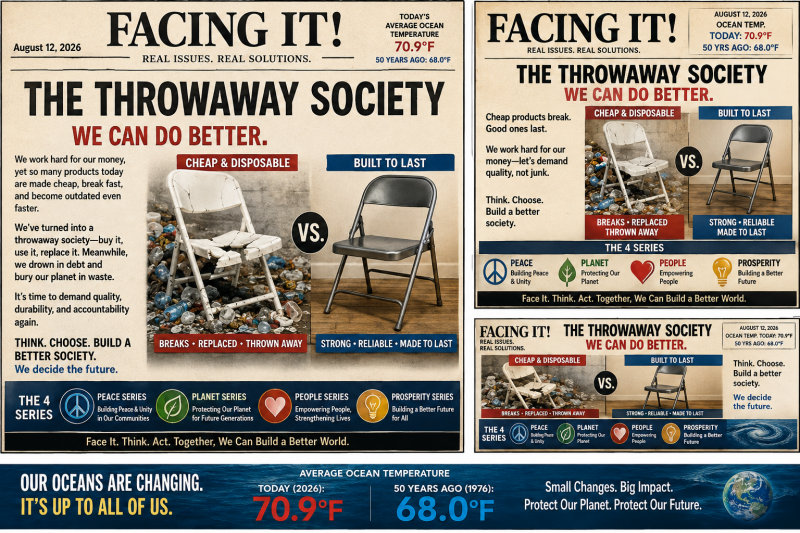
THE THROWAWAY SOCIETY
When Did We Stop Building Things to Last?
August 12, 2026
www.PeaceFourU.org
We work hard for our money.
Then we spend hundreds—or sometimes thousands—of dollars on phones, televisions, computers, watches, game consoles, appliances, and other technology.
At those prices, you would think we were buying something meant to last.
But a few years pass.
The software changes. The updates stop. An app is no longer supported. The battery becomes difficult to replace. A perfectly good device will not communicate with the newest one.
And suddenly we are told:
It is time to upgrade.
Again.
I understand that technology advances. I understand that companies have to innovate. But I also understand something much simpler:
I am not made of money.
Most working people aren't.
We work for what we own. We sacrifice for it. Sometimes we finance it and make payments for months or years. It is frustrating to finally pay for something only to discover that the world of technology has already decided it is old.
REMEMBER CRAFTSMAN?
There was a time when Sears sold Craftsman hand tools with a powerful idea behind them: a lifetime guarantee.
That guarantee said something about the product.
It said:
We expect this tool to last.
A father could buy a wrench, use it for years, and potentially pass it down to his son or daughter.
Today, we increasingly seem to have the opposite philosophy:
Make it. Sell it. Replace it. Repeat.
And if you want additional protection?
Buy the extended warranty.
Pay another fee.
Buy another protection plan.
Eventually, we have to ask ourselves whether we are building a better society—or simply a better system for selling people more stuff.
MADE TO LAST
I remember when “Made in the USA” represented something important to many Americans.
It wasn't simply about where something was manufactured. It represented pride in workmanship—the belief that if people spent their hard-earned money on something, it ought to perform its job and last.
Today our supply chains stretch around the world. Products and components come from the United States, Mexico, China, and many other countries.
The problem isn't simply who made it or what country made it.
The bigger question is:
What did we ask them to make?
If corporations demand the lowest possible manufacturing cost, rapid production, constant model changes, and maximum profit, shouldn't we expect durability eventually to lose the battle?
We cannot blame a factory worker thousands of miles away for a business decision made somewhere else.
We have to look at the entire system.
THE DEBT MACHINE
This is where Facing IT! becomes uncomfortable.
We consumers participate too.
We want the newest phone.
The bigger television.
The newest gaming system.
The latest watch.
Companies know it.
Marketing encourages it.
Financing makes it possible.
And before long, yesterday's amazing technology becomes today's junk drawer.
That creates a dangerous cycle:
WORK → BUY → FINANCE → UPGRADE → DISCARD → REPEAT
Is that progress?
Or have we slowly created a throwaway society that keeps working people permanently reaching for the next purchase?
FACE IT!
Technology should improve our lives.
Innovation should move humanity forward.
Profit is not inherently wrong.
Neither is manufacturing overseas.
But perhaps we should start demanding something besides newer.
Demand repairable.
Demand compatible.
Demand supportable.
Demand durable.
And when possible, reward companies that actually stand behind what they sell.
Because maybe the most advanced product isn't the one with the newest features.
Maybe sometimes it is the one that still works ten years later.
Before automatically buying the next upgrade, ask one simple question:
WHY AM I REPLACING SOMETHING THAT STILL WORKS?
Society needs to wake up.
But that starts with each of us doing something incredibly simple.
Think.
Think before buying.
Think before financing.
Think before throwing something away.
And think about the kind of economy our purchases are helping create.
We built a society capable of incredible technology.
Surely we are capable of building things worth keeping.
THE ECHO QUESTION
WHEN DID WE STOP EXPECTING THE THINGS WE BUY TO LAST?
Now it's your turn.
FACING IT!
www.PeaceFourU.org
If we wake up the storm eventually will pass... ✌️
FACING IT!
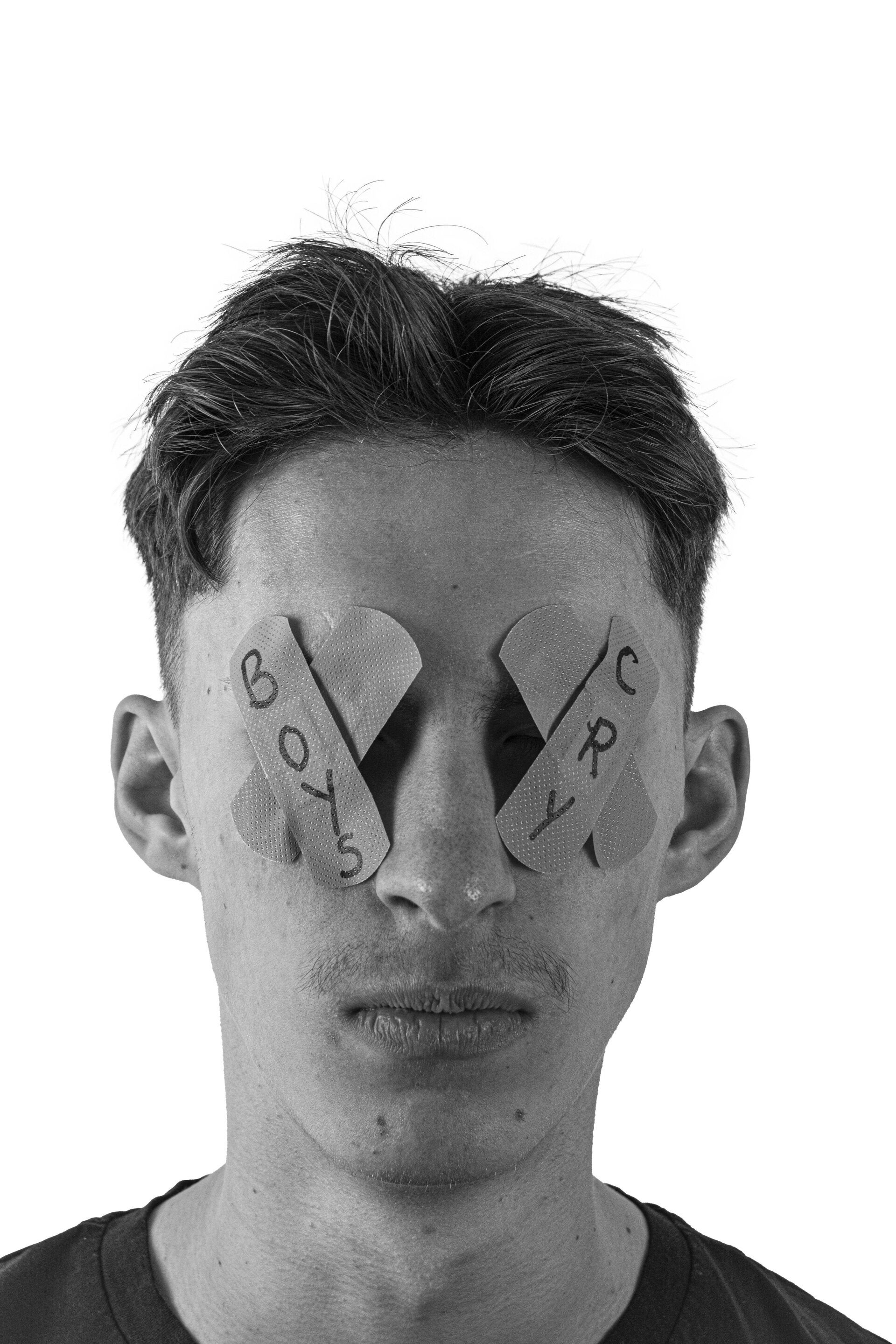
WHEN DID I BECOME OKAY WITH WHO I AM—AND WHAT I LOOK LIKE?
August 11, 2026
www.PeaceFourU.org
As a man, I never thought much about my appearance.
Actually, I take that back.
From my early twenties through my late thirties, I cared—a little. I was single, playing the field, and wanted to look attractive. Once I got married, however, I stopped caring as much. I gained weight and paid less attention to my appearance.
I told myself I was simply comfortable.
But was I comfortable—or had I become careless?
Sometime between the ages of forty and forty-five, I developed diabetes. At first, I did not believe it. I did not want to face what my body was telling me.
Then I lost something extremely important to me: my sight in my left eye.
That changed everything.
I finally began caring for myself—not to impress strangers and not to win anyone’s approval. I started caring because my health, my life, and my ability to see were worth protecting.
Health problems can completely change a person’s mindset. Sometimes we do not appreciate what our bodies provide until something begins slipping away.
My wife tells me she still finds me attractive. Could she be lying?
YES!
And I am perfectly fine with that.
I am no longer trying to impress the entire world. If my appearance benefits anyone besides myself, I want it to be the woman who chose to share her life with me.
But taking care of myself is no longer about whether she—or anyone else—likes what they see.
It is about liking myself enough to protect what I still have.
That is the truth I finally had to face.
Peace ✌️.

FACING IT!
THE MAN AT THE GAS STATION
When Do You Pull Your Head In—and When Do You Stand Up?
August 8, 2026
PeaceFourU.org
---
I saw a man walk into a gas station drunk, angry and belligerent.
He didn't like the prices.
So he decided to make sure everyone knew about it—especially the Indian man standing behind the counter.
The words coming from the customer's mouth weren't just complaints about gasoline. They became insults. Loud, disrespectful and ugly.
I stood there watching.
And something inside me changed.
Normally, I'm the guy who says nothing.
I tilt my head down and suddenly become very interested in my shoes.
I've learned to avoid confrontation. Maybe you have too.
Sometimes we pull our heads in because we don't want trouble.
That reminded me of a sea turtle.
When a sea turtle senses danger, it can pull its head and limbs inside its shell. The shell provides protection. It's an incredible survival mechanism.
I've done the human version of that for years.
Pull your head in. Keep quiet. Don't get involved. Let it pass.
But this time, I couldn't.
I was completely sober.
And I decided that I wasn't going to watch this man tear into another human being simply because he was angry about the price of gas.
So I spoke up.
And let's just say...
I almost got the hell beat out of me.
Was it smart?
That's something I'll probably wrestle with for a long time.
But here's what I know:
I felt good about my decision.
Not because I wanted a fight.
Not because I thought I was better than the man.
And certainly not because I wanted to be a hero.
I simply reached a point where keeping my head inside my shell didn't feel right anymore.
THAT'S THE QUESTION
Maybe courage isn't always about standing your ground.
Maybe courage is knowing when to stand your ground.
A sea turtle doesn't live with its head permanently outside its shell.
And it doesn't live with its head permanently inside it either.
It knows when danger requires protection.
And eventually, it knows when it is safe to come back out.
Maybe we need to learn the same lesson.
There are times when silence protects us.
There are times when walking away is the wisest thing we can do.
But there may also be moments when keeping our heads down becomes something different.
It becomes permission.
Permission for someone to hurt another person.
Permission for cruelty to become normal.
Permission for us to say later:
"I saw it happening, but I didn't want to get involved."
That night, I chose differently.
I came out of my shell.
And although I nearly paid a price for it...
I didn't regret it.
Maybe that's what Facing IT! is really about.
Not always winning.
Not always being right.
Not always knowing what will happen next.
Sometimes it's simply looking at yourself afterward and asking:
"Did I do what I believed was right?"
This time...
I believe I did.
---
FACING IT!
Think deeply. Live intentionally. Spread peace.
PeaceFourU.org
✌️ of MIND, BODY, and SOUL
Facing IT!
The Truth About Freedom
August 4, 2026 @ 11:24 AM
There are days when I wonder what society is becoming.
You work your tail off. You earn a paycheck. You pay your bills. You try to save money, but it never seems to stretch as far as you hoped. You search for better opportunities, start businesses on the side, invest your time into dreams, and wait... and wait... and sometimes nothing seems to happen.
You begin to ask yourself, What more is expected of me?
Sometimes it feels as though the people with the most money write the rules while everyone else simply learns how to survive within them. Every year things cost more. Every year it seems harder to get ahead. You wonder if you're running a race where the finish line keeps moving farther away.
Yet every morning, I still take my medicine.
I shower.
I shave.
I brush my teeth.
I get dressed.
I drive thirty miles through rush-hour traffic.
I walk into an office where I spend more waking hours with my coworkers than I do with my own family.
Why?
For a paycheck.
For benefits.
For responsibility.
Because that's what I was taught growing up.
Work comes first.
Play comes later.
School before fun.
If I was sick, I stayed inside. If my grades were bad—and they usually were—I was grounded. Nobody knew I struggled with dyslexia or attention issues. They simply thought I wasn't trying hard enough.
College wasn't much different.
I quit more than once.
Reading was exhausting. Paying attention was difficult. Managing time felt impossible.
But every time I walked away, I eventually came back because I believed education would give me more choices.
Eleven and a half years later...
I graduated.
Not because I was the smartest.
Not because it became easier.
Because I never completely quit.
Ironically, I've rarely needed that degree for the jobs I've held. The one position that required it was substitute teaching. Looking back, that almost makes me laugh.
So what was the degree really worth?
Maybe it wasn't about the diploma.
Maybe it proved something much more important.
Persistence.
Life keeps teaching me that success isn't always measured by titles, income, or possessions. Sometimes success is simply refusing to surrender when every reason says you should.
There are days I dream about walking away from all of it.
No deadlines.
No expectations.
No politics.
No endless chase for money.
Just freedom.
But is freedom really what we think it is?
Perhaps absolute freedom doesn't exist.
Every one of us answers to something—our families, our employers, our health, our responsibilities, our communities, or even ourselves.
Maybe freedom isn't the absence of responsibility.
Maybe freedom is choosing which responsibilities are worth carrying.
That realization changed how I think about peace.
Peace isn't waiting for the world to become fair.
Peace isn't believing governments or wealthy people will suddenly solve our problems.
Peace begins much closer than that.
It begins with the choices we make when no one is watching.
The Ripple Effect teaches that every decision spreads beyond ourselves. A smile, encouragement, honesty, forgiveness, or kindness may seem insignificant, but every action touches another life. Most of us will never know how far those ripples travel.
Facing IT! reminds us that avoiding reality never changes reality. We must face disappointment, injustice, fear, failure, and uncertainty with open eyes. Not because it's easy, but because pretending they don't exist only gives them more power.
The reason for life may not be accumulating wealth.
It may not be reaching retirement.
It may not even be finding perfect happiness.
Perhaps the reason for life is learning to become the kind of person who leaves every place a little better than they found it.
The world may never become perfectly fair.
But we can still choose fairness.
The world may never become perfectly peaceful.
But we can become peacemakers.
The world may never give us complete freedom.
But no one can take away our ability to choose integrity, compassion, hope, and love.
That choice belongs to each of us.
And maybe...
Just maybe...
That's the greatest freedom any of us will ever have. ✌️
- Bert Russell

Facing IT!
Whose Dream Are You Building?
7/31/2026 @ 11:59 PM
As a child, I was taught a simple principle:
"Do unto others as you would have them do unto you."
Another belief has guided me throughout my life:
Freedom holds no bonds.
Real freedom isn't about controlling someone else. It isn't about making people think like you, vote like you, work for you, or fear you. Freedom allows people to choose their own path while respecting the path of others.
Somewhere along the way, it feels like we've lost sight of that.
Too much of our world revolves around money instead of people. We celebrate wealth while many struggle to pay their electric bill, buy groceries, or afford a home. We argue over political victories while neighborhoods quietly fall apart. We reward division because division is profitable.
Political parties spend more time fighting each other than solving problems. Corporations answer to shareholders. Leaders find loopholes instead of leading by example. Too many people preach values they don't practice.
The result?
More greed.
More anger.
More violence.
More people feeling like they're working harder than ever while falling further behind.
A great nation isn't measured by the number of billionaires it creates.
It's measured by how it treats the people with the least power.
The strength of a country isn't found in its stock market.
It's found in its character.
Every generation inherits a choice. We can continue chasing bigger profits while trust disappears, or we can rebuild communities where honesty, compassion, and responsibility matter again.
Maybe that sounds naïve.
Maybe people will call it unrealistic.
But every meaningful change in history began with someone believing the world could become better before everyone else did.
So I'll leave you with one question.
Whose dream are you building?
Your own?
Or someone else's?
Because if your entire life is spent making another person's dream richer while yours quietly fades away...
Is that really freedom?
Or is it simply a different kind of chain?
Facing IT!
DON'T MOVE
7/30/2026 @ 9:42 PM
There are moments in life when two words can separate everything that comes before from everything that comes after.
"DON'T MOVE."
I know those words because I heard them for real.
My wife and I had spent the evening at a local bowling alley. We had been drinking, laughing, and talking with people we had just met. Like a lot of nights involving too much alcohol, I remember bits and pieces, but I couldn't tell you exactly what was said. The next morning, the conversations were gone. Alcohol has a way of stealing memories while leaving behind consequences.
What we didn't know was that someone had been paying attention.
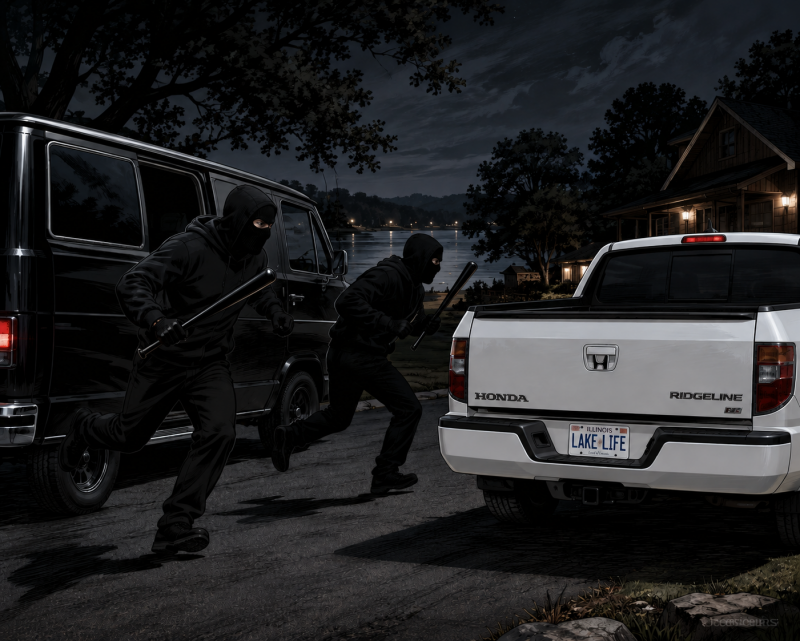
They followed us nearly five miles back to our quiet little lake community. It was the kind of place where people worried about boat motors disappearing from docks or fishing equipment walking away—not violent crime. You felt safe there. At least we did.
As we pulled into our driveway, everything changed in an instant.
CRACK!
The driver's side window exploded.
Glass sprayed everywhere.
The attackers had made one mistake. They thought I was driving.
Instead, my wife was sitting behind that shattered window.
Then I heard the words.
"DON'T MOVE."
That was probably the smartest advice anyone could have given me.
Unfortunately, I was drunk.
And when I drink, I don't always make smart decisions. I get stubborn. Hard-headed. Sometimes courage and stupidity wear the same face.
Instead of freezing, I threw open the passenger door and stumbled toward them.
I had no balance.
No fighting skills.
No plan.
Just anger.
They met me before I ever reached them.
The baseball bat came down again...
...and again...
...and again.
Across my head.
My chest.
My body.
I remember my wife screaming.
I remember the sound of the blows.
I remember trying to get back up.
Then headlights appeared as another vehicle rounded the corner into our neighborhood.
The attackers ran.
They left with nothing.
No truck.
No wallet.
No victory.
I took the beating.
They got nothing.
Looking back, I realize I wasn't brave.
I was lucky.
Luck isn't a strategy.
Alcohol clouded my judgment, and my pride convinced me I could stop something I wasn't prepared to stop. Had those headlights not appeared when they did, this story could have ended very differently.
Sometimes courage means standing your ground.
Sometimes courage means protecting the people you love.
And sometimes...
the bravest thing you can do is obey two simple words.
"DON'T MOVE."
Facing IT!
Life doesn't always test us when we're prepared. Sometimes it catches us tired, distracted, emotional, or under the influence. The decisions we make in those moments can echo for the rest of our lives.
That night taught me something I never forgot.
Strength isn't always found in charging forward.
Sometimes wisdom is found in knowing when not to move at all. ✌️
Facing IT!
The Knot
7/30/2026 @ 3:31 AM
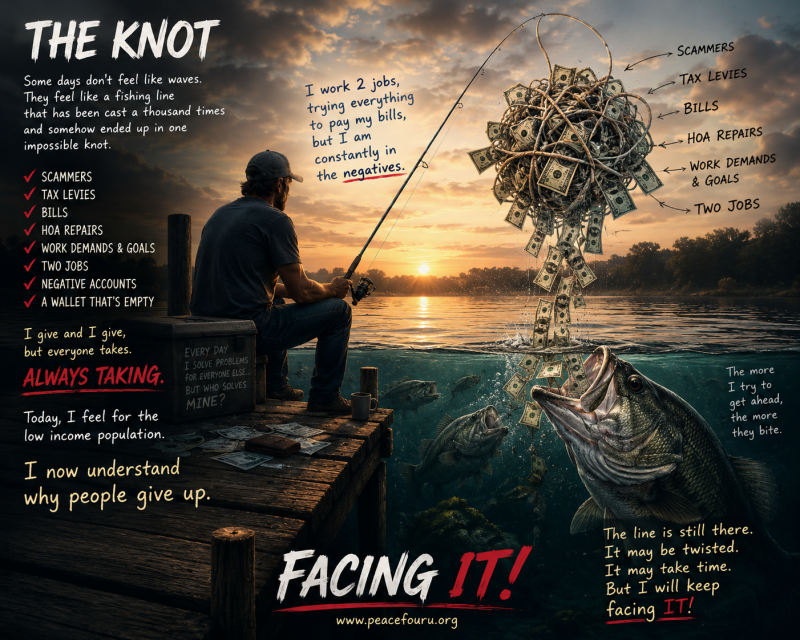
Some days don't feel like waves. They feel like a fishing line that has been cast a thousand times and somehow ended up in one impossible knot. You pull on one strand to loosen it, and three more tighten. You stop pulling, hoping your eyes will find the answer, but the knot just sits there, daring you to untangle it.
Today felt like that.
Scammers. Tax levies. Bills. HOA repairs. Work demands. Goals. Two jobs. Negative bank accounts. A wallet that feels lighter every time I open it.
Have you felt like this?
If so, please comment below: 👇
I spend my days solving problems for other people. Planning routes. Meeting deadlines. Paying bills the best I can. Trying to do the right thing. Trying to stay honest. Trying to keep moving forward.
Yet it often feels like everyone is taking.
Take another payment.
Take another fee.
Take another hour.
Take another piece of your peace.
Eventually, you stop asking, "How do I get ahead?" and begin asking, "How do I simply stay afloat?"
Today gave me a different perspective.
For years I have observed people living paycheck to paycheck. I have delivered to neighborhoods where people seemed to have given up. I wondered why someone would stop trying.
Today, I understood a little more.
When life keeps tightening the knot faster than you can loosen it, hope can begin to feel like another bill you can't afford.
But there is one thing a knot cannot do.
It cannot erase the line.
The line is still there. It may be twisted. It may take patience. It may even require cutting away damaged sections and starting again. But the line itself still exists.
Maybe that's where Facing IT! begins.
Not by pretending the knot isn't there.
Not by pretending everything will magically work out.
But by looking directly at the mess and saying, "This is where I am today."
Tomorrow, maybe one strand comes loose.
Then another.
And another.
Sometimes surviving the day is the victory no one else sees.

Facing it!
When Trust Becomes a Target
7/29/2026 @ 3:37 PM
There comes a point in life when many senior citizens begin to depend more on trust than speed. They grew up in a time when a handshake meant something, a letter in the mailbox usually came from someone important, and the telephone was a way to stay connected with family—not a tool for deception.
Today, that world has changed.
The mailbox is filled with advertisements designed to look like government notices. Phone calls come from numbers that appear local but lead to scammers. Emails, text messages, and official-looking documents all compete for attention. Some companies bury important information in tiny print that few people can comfortably read. Others create confusing offers that make people believe they have to act immediately.
Facing it means asking a difficult question:
At what point does marketing stop being persuasion and start becoming exploitation?
Not every business is dishonest. Many companies operate with integrity and genuinely care about their customers. But there are also organizations and criminals who understand that confusion can be profitable. They know that fear, urgency, and uncertainty can cause people to make decisions they otherwise never would.
As I spend more time in retirement communities, I hear the same stories repeated. "I thought it was real." "It looked official." "I didn't want to lose my benefits." These aren't stories of foolish people. They are stories of decent people trying to navigate a world that has become increasingly difficult to trust.
Maybe the measure of a society isn't how well it protects the strong.
Maybe it's how well it protects those who are the easiest to deceive.
Technology has made our lives faster, but it has also made deception easier. Every new convenience creates another opportunity for someone to misuse it. That's why transparency matters. Honest communication should be easy to understand, not hidden behind fine print or confusing language.
Facing it isn't about blaming every company or living in constant fear. It's about recognizing a growing problem and demanding something better.
A society earns trust one honest interaction at a time.
And once trust is lost, it is far more difficult to rebuild than it ever was to protect.
Do you agree?✌️

Facing IT!
Bought on a Phone, Canceled on a Computer?
7/29/2026 @ 7:42 PM
We hear companies talk about making everything "mobile friendly." They encourage us to shop from our phones, subscribe with one tap, and save our payment information for faster checkouts. It feels convenient—until you want to leave.
Recently, I discovered something that concerned me. I purchased a Peacock subscription through Amazon on my phone. When I decided to cancel it, I couldn't. Amazon directed me to use a desktop computer.
That made me stop and think.
What about the millions of people who don't own a desktop or laptop? Many people today do everything from their phones. They pay bills, apply for jobs, order groceries, and watch television. For some, a smartphone isn't a convenience—it's their only connection to the internet.
If a company allows someone to subscribe from a phone, shouldn't that same person be able to cancel from a phone?
This isn't about Peacock or Amazon alone. It's about accessibility, fairness, and giving consumers equal control over their own purchases. Convenience should work both ways. Signing up should never be easier than canceling.
Technology should remove barriers, not create new ones. If we truly live in a mobile-first world, then every important action—including canceling a subscription—should be possible from the same device that made the purchase.
Sometimes the biggest problems aren't hidden in complicated systems. They're found in the small frustrations millions of people quietly experience every day.
Do you believe this situation is ethical? ✌️

Facing IT!
The Streets That Taught Me
7/29/2026 @ 6:00 AM
Before moving to Kansas City, much of what I understood about life beyond my small-town world came from my own experiences, along with what I saw in movies and on television. Those stories shaped my expectations, but they also simplified a world that was far more complex than I realized. It wasn't until I began driving the streets of Kansas City every day that I discovered the biggest lessons about people, poverty, success, fear, and hope aren't found on a screen—they're found in real life.
I grew up in a relatively small town compared to the Kansas City metropolitan area. Looking back, I was sheltered. I understood hard work, family values, and responsibility, but I didn't fully understand the complexity of a large city. My view of the world was limited by what I had personally experienced.
That changed in 2004.
I moved to a suburb of Kansas City and started a small transportation business as an independent contractor delivering packages for a major corporation. My first route wasn't through quiet neighborhoods. It covered downtown Kansas City and many of the surrounding ZIP codes. Every day I drove through places most people only heard about on the evening news.
I saw the financial district come alive before sunrise. I delivered to luxury lofts and boarded-up buildings on the same street. One stop might be a law office, and the next might be someone struggling just to survive another day.
As the months turned into years, those streets became familiar. They taught me things that couldn't be learned from statistics or headlines. Poverty has a face. Success has a face. Addiction has a face. Kindness has a face. So does hopelessness.
I met business owners trying to keep their dreams alive. I met families working multiple jobs just to pay rent. I met people living under bridges who still smiled and wished me a good day.
Those encounters slowly changed me.
The city wasn't simply divided between good neighborhoods and bad neighborhoods. It was filled with people carrying burdens I couldn't see. Every person had a story, and most of those stories were far more complicated than I first imagined.
That realization has stayed with me.
When people ask why I write about homelessness, poverty, or life's struggles, the answer is simple. I didn't learn about these subjects from books. I learned them through thousands of conversations, millions of miles behind the wheel, and years spent walking into businesses, homes, shelters, hospitals, warehouses, and neighborhoods across Kansas City.
Those streets became one of my greatest teachers.
Sometimes life places us exactly where we need to be—not because it's comfortable, but because it's where we'll finally begin to see the world through someone else's eyes.
Looking back, I thought I was delivering packages.
In reality...
Kansas City was delivering an education to me.


Facing IT!
The Shopping Cart Test
7/26/2026 @ 12:13 PM
A shopping cart has no engine. No opinions. No emotions. It simply waits for someone to decide what to do with it.
Yet every grocery store parking lot tells the same story.
Costco. Sam's Club. Walmart. Trader Joe's. Whole Foods. Sprouts. It doesn't matter where you shop. Carts are scattered beside cars, resting against light poles, shoved into landscaped islands, or abandoned in empty parking spaces. They seem to end up everywhere except where they were designed to go.
Why?
Some people say, "The store pays employees to collect them."
Others think, "I'm in a hurry."
Some simply don't care.
The strange thing is that returning a cart usually takes less than a minute.
There isn't a reward for doing it.
There isn't a punishment for leaving it.
No one hands you a receipt that says, "Congratulations, you're a good person."
The shopping cart has quietly become a test of character.
It measures something much deeper than responsibility. It asks a simple question:
Will you do the right thing when nobody can make you?
Every abandoned cart creates a ripple.
A cart left loose can roll into someone's vehicle, costing them time and money. It can block a parking space for the next customer. It becomes one more task for an employee who already has plenty to do. Small decisions create consequences we rarely stop to consider.
Returning the cart doesn't make you rich.
It doesn't make you famous.
It won't change the world overnight.
But it reveals something about the kind of person you are becoming.
Character isn't built by the big moments everyone notices.
It's built by the hundreds of tiny decisions no one remembers.
The shopping cart is one of those decisions.
Because integrity isn't measured when people are watching.
It's measured in an empty parking lot... when no one is. ✌️
Facing IT!
Killer Moon
7/26/2026 @ 7:41 AM
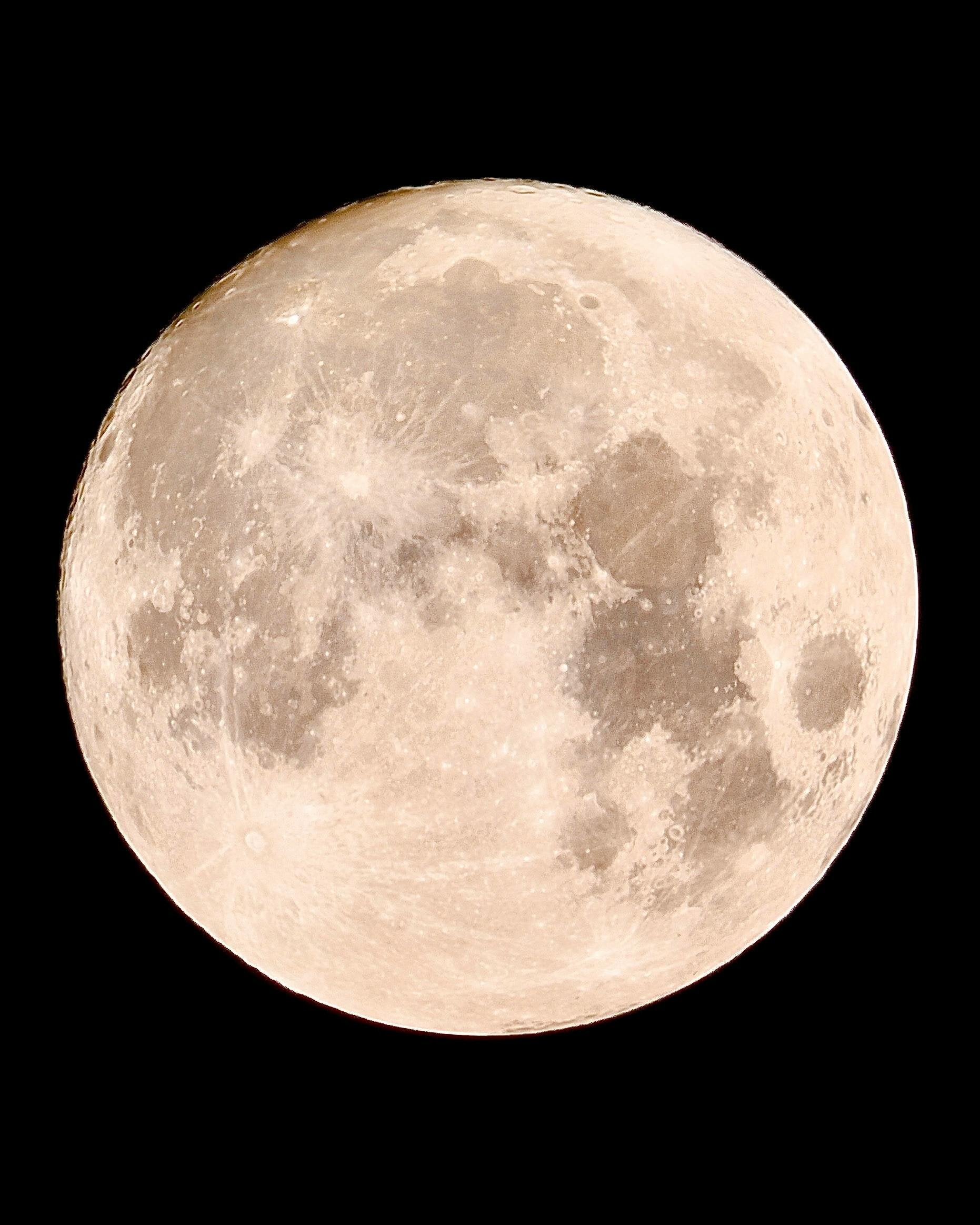
There are nights when the Moon seems brighter than usual.
To most people, it's just another beautiful full moon.
To those who live on the water, it means something more.
They know the Moon's gravity will pull harder. The tides will rise higher... and later, they'll fall lower than expected. Rocks, stumps, sandbars, and hazards that were hidden beneath the water suddenly appear.
The Moon didn't create those obstacles.
It simply exposed them.
Life has its own killer moons.
Moments when an unexpected loss, a broken relationship, financial hardship, illness, or failure pulls the water away from everything we thought was secure.
It feels cruel.
It feels unfair.
But the truth is, those moments rarely create our problems.
They reveal them.
Low tide exposes weak foundations.
It reveals neglected priorities.
It uncovers fears we've buried, truths we've avoided, and dreams we've abandoned.
Facing it means resisting the urge to blame the Moon for what was already beneath the surface.
The Moon didn't put the rocks there.
The tide simply allowed you to see them.
That's the gift hidden inside every difficult season.
You finally have the chance to remove the obstacles, repair the damage, or chart a better course before the water rises again.
Most people pray for high tide.
Wisdom often arrives with low tide.
Because you can't fix what you refuse to see.
Sometimes the hardest nights become the most valuable ones—not because they break you, but because they reveal what needs your attention.
The Moon will continue to pull.
The tides will continue to change.
The question isn't whether low tide will come.
The question is whether you'll have the courage to face what it reveals. ✌️
Facing IT!
Wearing Someone Else's Life
7/24/2026 @ 10:10 PM
There comes a point in life when you have to ask yourself a difficult question.
"Am I living my life... or the life I thought everyone expected me to live?"
That's not an easy question to answer.
Most of us don't wake up one morning and decide to become someone we're not. It happens gradually.
We change the way we speak to fit into a group.
We hide our opinions to avoid conflict.
We smile when we're hurting.
We laugh at jokes we don't find funny.
We wear masks so often that eventually we forget what our own face looks like.
I've been guilty of it.
For years, I tried to become the version of myself that I thought others would accept. I wanted to fit in. I wanted people to like me. I wanted to belong.
The strange thing is, the harder I tried to fit in, the less I felt like I belonged.
It took me years to understand why.
You can fool the world.
You cannot fool yourself.
Every compromise with your character becomes another knot in the rope that's slowly pulling you away from who you were meant to become.
People often ask me why I spend so much time observing others.
The answer is simple.
I'm trying to understand myself.
Every person I meet teaches me something.
Some teach me who I want to become.
Others teach me who I never want to be.
Both are valuable.
I've spent my life watching people in truck stops, hospitals, boardrooms, coffee shops, estate sales, and around campfires. I've watched kindness change someone's day. I've watched pride destroy relationships. I've watched words heal and words wound.
Life is the greatest classroom ever built.
The problem is that too many people graduate without ever paying attention.
One day, every one of us will leave this world.
Someone else will sort through our belongings.
Someone else will tell our stories.
Someone else will remember the way we treated people.
They won't remember how well we fit in.
They'll remember how genuine we were.
That's the person I want to become.
Not perfect.
Not famous.
Not admired by everyone.
Just honest enough to live a life that actually belongs to me.
Facing IT! has never been about finding all the answers.
It's been about asking the questions we've spent too long avoiding.
So today, I'll leave you with one.
If no one else's opinion mattered... who would you become?
Drop your anchor there.
Because that's where you'll find yourself. ✌

Facing IT!
"The Current I Couldn't Control"
7/20/2026 @ 9:01 AM
There are moments in life when one mistake exposes something much deeper than the mistake itself.
Taking my sister Ellen to the airport should have been simple.
The night before, I promised her I'd be ready at 3:00 a.m. She asked me several times if I was sure. Each time I answered with confidence.
"Don't worry. I've got it."
I believed it.
For the past nine months, waking up around 2:00 a.m. had become routine. Most people would assume I wake up that early because my job requires it.
It doesn't.
My job requires something much different.
It requires that my plan works.
For more than twenty-five years, transportation has taught me to think several moves ahead. I don't simply dispatch trucks. I build plans that have to survive real life. One extra pallet can overload a trailer. One driver's delay can ripple through an entire day. Weather changes. Equipment fails. Customers add orders. Capacity disappears.
Every decision affects another decision.
My mind never really stops playing that game.
Long after I leave work, I'm still solving problems that haven't happened yet.
I thought that made me prepared.
That night proved otherwise.
I climbed into bed exhausted. My wife suggested I pack before going to sleep.
"I'll do it in the morning," I said.
I laid there for hours with my thoughts racing. Eight o'clock became ten. Ten became midnight. I couldn't seem to fall asleep.
The next thing I remember was someone pushing my shoulder.
It was 3:15 a.m.
It was Ellen.
I had slept through my alarm.
In an instant, I went from complete confidence to complete chaos.
I apologized over and over while trying to wake my body. I stumbled through the house, rushed through a shower, forgot my keys, woke my wife, and became furious with myself.
Then came the thought that hit me harder than anything else.
"You're so lazy."
I believed it.
At least for a few minutes.
Then I started replaying the previous evening in my mind.
The long workdays.
The constant planning.
The endless mental chess match.
The weeks...
The months...
The years of carrying responsibility home with me.
Suddenly, another thought replaced the first one.
"Maybe I'm not lazy."
Maybe...
I'm exhausted.
There is a difference.
That realization didn't excuse my mistake.
I still overslept.
I still wasn't prepared.
I still let people down.
But it changed the way I looked at myself.
For years, I had measured strength by how much I could carry.
If I was tired, I pushed harder.
If I made a mistake, I criticized myself before anyone else could.
If I felt overwhelmed, I convinced myself I simply needed to work more.
I never stopped to ask whether the load itself had become too heavy.
Later that morning, as I drove home alone, I thought about the tides along the South Carolina coast.
Fish don't fight every current.
When the tide comes in, they move with it.
When it goes out, they adjust again.
They don't waste energy trying to prove the water wrong.
Nature understands something I've spent much of my life forgetting.
Strength isn't fighting every current.
Strength is knowing which currents deserve your energy.
For years, I fought exhaustion as though it were an enemy.
Maybe it wasn't.
Maybe it was my body trying to tell me something my mind refused to hear.
Facing it wasn't admitting defeat.
Facing it was admitting I am human.
I can plan routes.
I can solve problems.
I can think several moves ahead.
But I cannot outrun exhaustion forever.
Sometimes the strongest thing we can do isn't push harder.
Sometimes the strongest thing we can do is finally face the truth we've been carrying all along.
I wasn't lazy.
I was exhausted.
There is a difference. ✌️
Facing IT! — Looking Past Our Differences
by Bert Russell
7/6/2026 @ 7:54 AM
There are some questions that never seem to leave my mind.
The older I become, the less interested I am in proving that I am right and the more interested I become in understanding why we believe what we believe.
Our world is filled with different races, religions, languages, cultures, and traditions. Some people see those differences as barriers. I see them as opportunities to learn.
Growing up, I learned the story of Adam and Eve. Later, I learned about science, genetics, and the history of civilizations. Did I find all the answers?
No.
I found more questions.
And I'm okay with that.
One thing I have learned is that questions don't divide us. Pride does.
Whether you believe humanity began with Adam and Eve, evolved over countless generations, or hold another belief entirely, we all wake up each morning with many of the same needs.
We all want to be loved.
We all want to belong.
We all experience joy, loss, fear, hope, disappointment, and happiness.
We all leave footprints behind.
So why do we spend so much time focusing on the things that separate us?
Why is someone's race more important than their character?
Why is someone's religion more important than how they treat other people?
Why does a language, a nationality, or a family heritage become a reason to hate?
These are questions I cannot answer.
But I believe we have to be willing to face them.
Maybe the greatest challenge isn't changing the world.
Maybe it's changing ourselves.
Facing our own assumptions.
Facing our own fears.
Facing the moments when we judge before we understand.
Facing the temptation to place people into groups instead of seeing them as individuals.
Peace doesn't begin in a government building.
It doesn't begin on social media.
It doesn't begin by winning an argument.
It begins when one person decides to treat another human being with dignity and respect—even when they disagree.
That's not weakness.
That's courage.
The world may never agree on every belief, every religion, every culture, or every tradition.
And perhaps it never will.
But we can choose something greater.
We can choose kindness over contempt.
Understanding over assumption.
Conversation over conflict.
Respect over hatred.
Sometimes the hardest person to face...
is ourselves.
That's where peace begins. ✌
FACING IT! End of the Month of May
Review

Facing It! – End of the Month Summary
by Bert Russell
5/31/2026 @ 8:01 AM
At the end of this month, I asked myself a simple question: Did I take a step forward, or did I take a step backward?
Looking back honestly, I took a step forward. Not because my problems disappeared, my anxiety vanished, or life suddenly became easier. I moved forward because I faced what was in front of me instead of turning away from it.
This month taught me that peace of mind, body, and soul is not achieved by eliminating uncertainty, frustration, or fear. It is developed by learning how to live with them without allowing them to control my direction. Through anxiety, difficult decisions, self-reflection, nature, and quiet moments of awareness, I began to understand that peace is not a destination waiting somewhere in the future. It is a choice I make each day.
The waves continued to roll. The breeze continued to blow. The birds searched, the ants adapted, the turtles floated, and the snake followed its path through the unknown. Nature never demanded certainty before moving forward, and neither should I.
The greatest lesson I learned this month is that growth does not always look like giant leaps. Sometimes growth is simply becoming more aware of my thoughts, my actions, my reactions, and the subtle signals life sends along the way.
I did not become perfect this month.
I became more present.
And that may be the most important step forward of all. ✌️

FRUSTRATION AND FIRE - 5/24/2026 @ 8:22 PM
The smoker erupted into flames again over Memorial weekend, even after Martha and I tore it apart cleaning grease, ash, smoke, and every hidden corner we could reach. She scrubbed the grilles while I scraped the smoke stack and drip tray clean, both of us thinking calmer water was finally ahead. But life has a strange way of sending another wave the second you think you’ve reached shore.
Facing It! means realizing some fires are not there to destroy you — they are there to test whether you’ll abandon the boat or grab the wheel tighter. So while the smoke rolled through the backyard and frustration burned hotter than the coals, we stood there together like two surfers caught in rough water… knowing the next wave was still coming, but paddling back out anyway.
Failure only wins when the ocean convinces you to stop swimming. ✌️
FACING IT!
“Lines Under Tension”
5-14-2026 @ 6:14 AM
There’s a certain silence that hits different
when your bank account is low,
the bills are due,
and your paycheck already has destinations
before it even touches your hands.
You start stretching dollars
like old fishing line that’s been frayed too many seasons —
pulling it tighter…
and tighter…
hoping it doesn’t snap in the middle of the fight.
One bill gets paid.
Two more surface like shadows beneath dark water.
So you cut corners.
Skip meals.
Delay repairs.
Convince yourself the strange engine noise
“can wait another month.”
You start fishing with whatever life leaves in the bucket —
half-torn worms, rusted hooks, bargain-bin tackle,
dreams patched together with duct tape and stubbornness.
And still…
you cast.
Because quitting doesn’t feed anybody.
Quitting doesn’t stop the current.
Quitting doesn’t silence the pressure squeezing your chest
at 2:13 in the morning while the ceiling fan spins like a helicopter above a battlefield.
Then one day, it happens.
The line jerks hard.
Not a nibble.
Not false hope.
Something massive.
Life digs deep into the water
and grabs hold with everything it has.
The rod bends so hard
you swear it’s going to break in half.
That’s the moment most people panic.
But peace…
real peace…
isn’t calm water.
Peace is learning how to breathe
while the boat rocks violently beneath your feet.
It’s understanding that fear pulls harder
when you fight against every wave emotionally.
So instead of yanking the rod in desperation,
you steady yourself.
You loosen your grip.
Adjust the drag.
Trust your balance.
And suddenly the fight changes.
Not because life got easier —
but because you stopped letting desperation steer the boat.
The bills are still there.
The opportunities still feel small.
The current still pulls hard enough to drown weak minds.
But somewhere between the exhaustion and the sunrise,
you realize something powerful:
The fish was never trying to destroy you.
The fight was teaching you
how strong your hands really are.
And peace?
Peace was never sitting safely on the shoreline.
Peace was finding calmness
with the line still under tension. ✌️
Why don’t fish ever pay bills?
Because they already live below net income. ✌️
Looking for more - Head to "Written Waves" at www.lakelife4u.com
5-13-2026 - Entry - (4:13 am)
Facing IT! — Peace becomes a trouble factor when life keeps cutting across your path like a boat throwing hard wakes into calm water. Bills crash from one side, mortgages from the other, and every wave seems designed to pull you under before you ever find your balance. Degrees that once promised smooth water now feel like old ski ropes frayed by time, while salaries drift farther away from the weight people carry. Skill and performance no longer guarantee a steady pull from the boat; too often politics decides who stays upright and who sinks beneath the surface.
Water skiing teaches a brutal truth about crossing wakes with limited speed. If the boat slows down too much, the skier loses lift and the skis begin to sink. Fear creeps in when the wake rises ahead like a wall of water, and instinct tells you to lean back, stiffen up, or let go of the rope entirely. But crossing wakes requires controlled balance, bent knees, and trust in forward motion even when the water is fighting against you. Panic creates instability. Tension digs the ski edge too deep into the wake and throws the skier sideways.
Life works the same way. Peace is not the absence of waves — it is learning how to absorb the impact without surrendering your direction. A person with limited means often feels like they are skiing with barely enough pull to stay above water, constantly crossing the wakes created by inflation, debt, expectations, and disappointment. Yet survival comes from learning how to angle through the turbulence instead of trying to outrun it. The wake may slam against you, spray may blind you for a moment, but the shoreline is still ahead.
Facing IT! means understanding that rough water does not always mean failure. Sometimes the hardest wakes are proof you are still moving forward. ✌
5-3-2026 - Entry - (1:27 am)
Facing It! (start — direct, confrontational)
The water hasn’t even moved yet—and you’re already thinking about letting go.
That’s the temptation no one talks about.
Not the fall.
Not the crash.
But the quiet decision to quit before anything even begins.
You feel it in your grip on the rope.
Too tight. Too unsure.
Your legs aren’t failing—you just don’t trust them yet.
So you lean wrong on purpose.
You let your balance slip.
You tell yourself, “See? I knew I couldn’t do it.”
But the truth is harder than that.
You didn’t fall.
You let go.
The current doesn’t wait. Neither should you.
→ But understanding that doesn’t calm the water inside you…
→ Continue in Written Waves
4-27-2026 - Final Weekend Entry (6:20 am)
Forgiving yourself - The Hardest part - Facing the Truth!
Message:
FACING IT!!!
FACING IT!!!
Wakeboarding doesn’t lie.
The boat pulls at a constant speed.
The rope stays tight.
The water reacts the same way—every time.
If you’re off balance, you feel it immediately.
If you pull too hard, you get dragged.
If you lean back too far, the board slips.
The facts don’t change.
Only you do.
I’ve hit a wall again.
But this time… it’s different.
This isn’t failure.
This is the moment right before you get up.
For 31.4 years, I’ve been running.
Holding on the wrong way.
Fighting the pull instead of working with it.
Thinking effort alone would get me there.
And just like wakeboarding—
That’s not how it works.
You don’t get up by pulling harder.
You get up by setting your feet,
bending your knees,
keeping your arms steady,
and letting the boat lift you.
You stay centered.
You stay grounded.
You let the system work.
That’s what I’ve been missing.
Not strength.
Alignment.
So now I’m facing it.
Not running.
Not avoiding.
Not overthinking the next move.
Do you know what I’m facing?
Maybe not.
Do you know who I am?
Maybe not yet.
But you will.
Because this time, I’m not letting go.
This time, I’m learning how to stand.
July 1, 2026.
That’s the line.
That’s the shoreline.
That’s where this ride leads.
This isn’t the end of something.
This is the first time I’ve actually done it right. not perfect, but actually making a full effort without stopping... Giving it my all...
The Sneak peek PREVIEW
of
"THE LAST DISPATCH"
And when it clicks—
You don’t question it.
You ride it.
If you enjoy my Philosophies catch me on/at? www.lakelife4u.com or www.H2Olifestyles4u.com
Coming Soon! the Shoreline - The Last Dispatch!
Peace of MIND, BODY, and SOUL. ✌
4-27-2026 - Triumph and Failure
Message:
FACING IT!!!
I used to chase waves the hard way.
Head down. Arms burning. Freestyle.
Fighting the ocean like it owed me something.
Every time I got close—
my left pinky toe would cramp.
My rhythm would break.
And the wave would pass.
Same ending. Different day.
I thought the problem was effort.
So I pushed harder.
For two years.
Harder didn’t fix it.
It just repeated it.
Then I went back.
Not to the ocean—
to the beginning.
To being a kid with my father,
learning to body surf on small waves.
No fight.
No force.
Just timing.
Feel the pull.
Let the wave lift you.
Move with it.
So I changed.
Lifted my head. Slowed down.
Switched to a stroke that felt natural again.
Breaststroke.
Not weaker—
truer.
The wave didn’t change.
I did.
And that’s when I felt it.
Not the ride.
The alignment.
Facing it isn’t about fighting harder.
It’s about seeing what’s not working,
letting go of the wrong way,
and returning to what’s real.
Again and again.
Until it clicks.
Because the wave isn’t the lesson.
The way you meet it is.
And when you finally stop fighting it—
You don’t just catch it.
You understand it.
Want more catch me at www.lakelife4u.com or www.h2olifestyles.com
Peace of mind, body, and soul. ✌
4-22-2026 - ANXIETY
FACING IT!
You’re in the water again.
But this time—it’s louder inside your head than outside.
Board drifting. Rope in your hands.
And already—you’ve seen it.
The fall.
Not real… but vivid.
Your mind runs it like a highlight reel:
The handle rips from your grip.
Your body snaps forward.
Cold water slams your face.
Silence. Failure. Reset.
It hasn’t happened—
but it feels like it already did.
Your chest tightens.
Your tongue tastes like metal.
Your fingers twitch around the handle.
The boat revs.
And right there—right before the pull—
you’re split in two:
One voice says:
“Don’t go. You already know how this ends.”
The other is quieter…
but sharper:
“Do it anyway.”
The rope snaps tight.
You get yanked forward—hard.
Water explodes around you.
Your arms scream to clamp down, to control it, to survive it.
And that mental image?
It comes rushing back mid-pull—
You see yourself eating it.
Feel it before it happens.
That’s when most people lose it.
They fight.
They panic.
They confirm the fall before it even arrives.
But not this time.
Something in you snaps back.
Not fear—
determination.
A raw, stubborn refusal to let the imagined fall become real.
You don’t overpower it.
You don’t win clean.
You just… decide.
And that changes everything.
Your grip loosens—just enough.
Your breath punches back into your lungs.
Messy. Uneven. But it’s there.
You stop trying to control every inch of the pull.
You stop arguing with the moment.
You let the rope be strong.
You let your body adjust.
The board chatters… then steadies.
Your legs stop shaking—just a little.
And that mental image?
It fades.
Not because you erased it—
but because you outlived it.
You’re up.
Heart still pounding.
Arms still burning.
But you’re riding.
And now you know something deeper than confidence:
The fall in your mind isn’t the truth.
It’s just noise under pressure.
Message To self:
You imagine the worst
You don’t beat anxiety by eliminating fear.
You beat it by proving—again and again—
that even when your mind shows you the fall…
You can still rise.
Next time that image hits—don’t push it away. Push through it!
And hey… worst case? You fall, get soaked, and look like a legend doing it 😏✌️
Beyond on the Ordinary

4-21-2026
Written Waves: Surfing the Impossible
Some waves are never meant to be ridden—at least that’s what they tell you from the safety of the shore. Too high. Too wild. Too dangerous. Impossible. But I have learned that the word impossible often comes from people who have never paddled into deep water.
I could smell the salt in the wind before I ever saw the swell rising. The sky darkened like a warning, and the horizon stood up taller than fear itself. My hands gripped the board, wax rough beneath my fingertips, while the cold water bit at my skin. In that moment, I could taste adrenaline sharper than the ocean on my lips.
The wave coming for me looked bigger than anything I had faced—failure, doubt, loss, judgment, pain—all of it rising at once. Every instinct said turn back. Every voice from the beach said I would wipe out.
But impossible has a strange weakness: it only lives until someone drops in.
So I paddled forward.
And what happened next became the story the shore never saw.
Message to Self:
Never let the comfort of the shore define the limits of your ocean. Those who call it impossible often speak from dry sand, not deep water. Trust the sting of the salt, the shake in your hands, and the fear in your chest—they are signs you are alive and paddling toward something greater.
The wave was never sent to destroy you. It came to show you that courage is born the moment you move forward when every voice says retreat.
Keep paddling. The shore does not get to tell your story.
FACING IT!
4-18-2026
Facing the Different Road
I spent years wondering why my road looked harder than everyone else’s. Why simple things took more effort, why learning came differently, and why progress sometimes felt slower than it should. Dyslexia gave me challenges I never asked for—but it also gave me strengths I never expected.
It taught me patience when others rushed. It taught me problem-solving when others followed instructions. It taught me grit when quitting would have been easier. While others traveled smooth pavement, I learned how to walk rough ground.
For a long time, I saw the different road as punishment. Now I see it as preparation. Every obstacle trained me. Every frustration sharpened me. Every detour built endurance.
I no longer ask why my road was different. I ask what it was trying to teach me.
Because the truth is, the harder road did not break me—it built me. And once I faced the different road, I realized it had been leading me exactly where I needed to go all along.
Message to self:
What once felt like struggle may have been guiding me toward wholeness. Peace often arrives not when life becomes perfect, but when I became aligned with who I am.
True peace comes when I stop resisting my journey and I start flowing with it.
Instead of fighting every hardship, detour, or difference, I have learned to accept my path and grow through it. ✌
Facing it!
Sometimes my mind doesn’t move in a straight line.
It’s not point A to point B.
It’s more like a map.
Imagine driving from Chicago to St. Louis.
It’s not a straight shot.
You take turns… highways… back roads… adjusting as you go.
The only straight line is one you never actually travel.
That’s how my thoughts work.
I start north… then shift northeast…
Then somehow I’m somewhere else entirely.
Northwest… west…
And somewhere along the way… I lose track of where I was going.
For a moment… everything feels scattered.
Like I had something clear…
and it slipped through my hands.
That’s what reading can feel like too.
I’m not just looking at words.
I’m navigating them.
Trying to find the direction they’re supposed to go…
while my mind is already exploring three other paths at the same time.
That’s the part people don’t see.
They see the pause.
But they don’t see the movement underneath it.
Because even when I look lost…
my mind is still working.
Still mapping.
Still searching for the right direction to land.
And when it finally does…
it’s not just one path.
It’s the whole map.
For most of my life, I thought this meant I was falling behind.
That I was taking too long.
That I was somehow missing something everyone else understood.
But I wasn’t lost.
I was processing… differently.
Taking in more directions…
before choosing where to land.
Facing that truth changed everything.
Because the problem was never the way my mind moved.
It was trying to force it into a straight line it was never built to follow.
Now I don’t fight the map.
I learn from it.
And when everything finally comes together…
it’s not confusion.
It’s clarity… earned the long way.
If you’ve ever felt like you were losing your thoughts…
or falling behind…
maybe you’re not lost either.
Maybe you’re just seeing more than one path at a time.
→ If this question has ever crossed your mind… it started here: Written Waves
Message to self:
Clarity doesn’t always travel in a straight line.
By George Russell also know as Bert Russell
I Lost the Business… But That Wasn’t the Worst Part
I thought building a business would be the hardest part of my journey. I was wrong. Building it took hard work, long nights, sacrifice, and ambition—but losing it forced me to face things success had hidden from me for years.
I learned how to grow one truck into an empire, how to build teams, create systems, manage profit, and lead people toward a common goal. What I did not learn was how quickly titles, possessions, and momentum can disappear when life changes course.
When the business fell, the real work began. Not rebuilding income. Not rebuilding status. Rebuilding myself.
What I had to face next was something no business plan could prepare me for.
Message to Self:
New beginnings for me never start with lemons or roses—they begin with dirt, dust, and life thrown straight in my face. Yet somehow, that’s always where the strongest roots begin to grow.
By George Russell - AKA Bert Russell 4-19-2026, 9:56 am
Continue the journey at LakeLife4U.com, where the water taught me what the grind never could. Written Waves -
