

The ECHO - Facing IT!
Embark on a journey of reflection and discover the power of your own thoughts. The ECHO is a series designed to inspire, question, and encourage you to take that vital first step towards a more peaceful world.

Your journey, your choice
Every step, no matter how small, has the potential to create a ripple effect across our world. The ECHO series invites you to engage with questions that matter, prompting you to think deeply about your actions and their impact. Will you choose to respond?

Changing the world, one baby step
We believe that every human possesses the power to change perspectives and shape the future of our planet. This page is dedicated to those who dare to think, to question, and to act. Your conscious choices today pave the way for a lasting legacy for future generations. Let's make rational steps forward together.

My truth, your reflection
Through personal stories and candid reflections, I will share how I navigate life's challenges and face the truth. This is not about persuasion, but an invitation for you to consider your own journey. The choice to engage and react is entirely yours, one baby step at a time.
ECHOES
Facing IT!
What We Call Valuable
Lawrence and Ralphy met me at 7:30 this morning, about three hours earlier than usual. As soon as I saw them, my stomach dropped.
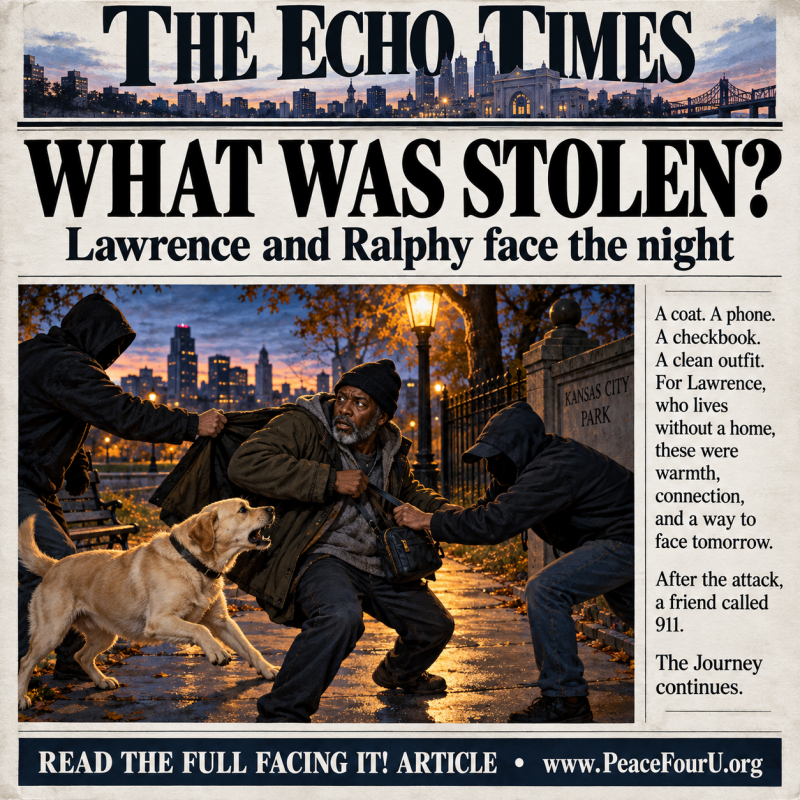
Lawrence had a swollen black eye. I could see blood coming from his ear. He told me that he and Ralphy had been jumped shortly after sunset. Ralphy had tried to scare the attackers away, but Lawrence had been badly beaten.
They took his jacket, cellphone, and checkbook. They also took the second clean outfit he kept in his file cabinet.
I called 911. Then I took Ralphy in my SUV and went to the hospital.
I keep thinking about that list. At home, I can hang up a coat and choose another. I can charge my phone, open a drawer for clean clothes, and find something to eat. I rarely stop to think about what those things make possible.
For Lawrence, a jacket means warmth when he has no door to close against the cold. A cellphone can mean a way to call for help. A clean outfit means having something ready for the next day. Even the beef jerky I shared with him and Ralphy means more when storing food is difficult.
The attackers stole more than objects. They took pieces of the routine Lawrence had worked to build for himself and Ralphy.
I cannot claim to understand what living without a home feels like. Today showed me how much I have taken for granted, and how quickly someone with so little can lose what they depend on.
Lawrence and Ralphy are at the hospital. I do not know yet what comes next.
The Journey continues.
ECHO
Facing IT!
Ralphy Got There First
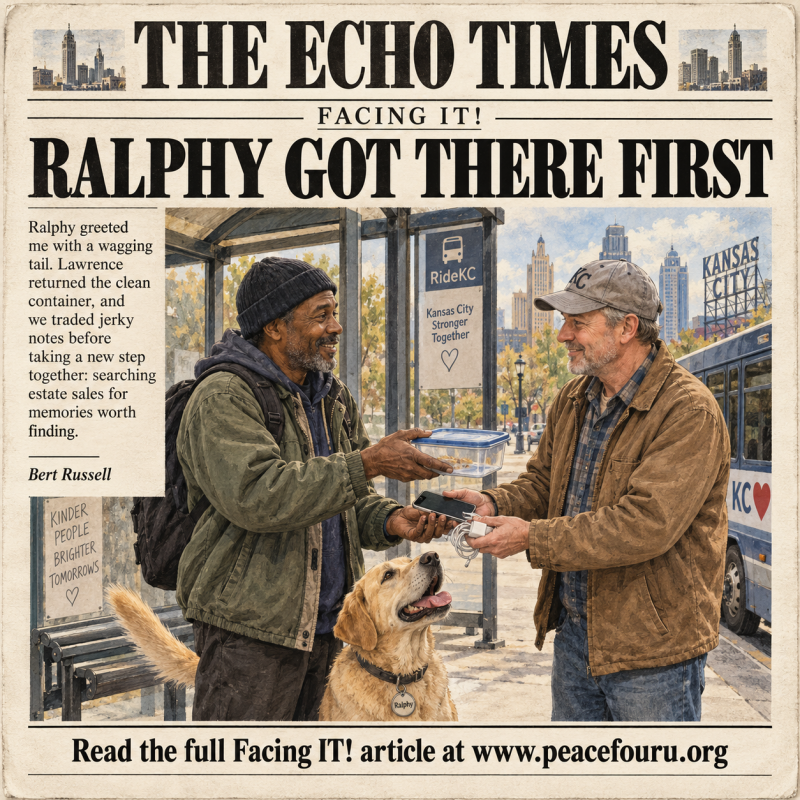
I saw Ralphy before I saw Lawrence.
He came running toward me, his tail wagging so fast that the rest of him seemed to follow it. I bent down to greet him. I had learned that he loved a rub behind his ears. He didn’t care for pats on his head, and he didn’t want anyone touching his paws.
So I rubbed behind his ears and talked to him. I had a little spicy beef jerky, too. He gobbled it up without chewing, then stayed close while I kept rubbing his ears. We talked like two people discussing the weather. I did most of the talking, but Ralphy seemed happy with the arrangement.
Lawrence finally caught up, carrying the Tupperware container I had given him last time. It was washed and so clean that it looked better than it had when it was mine.
I handed him another container.
“I hope this batch is spicier than your last one,” he said.
“Really?”
“Yes.”
“I used Thai peppers and Trinidad peppers in the marinade.”
“Awesome. Did you use more garlic cloves?”
“Yes.”
“Great. We’re going to get this dialed in, George.”
“Cool.”
I asked Lawrence if he had still been learning about the memories behind estate sale finds. He said he had, then asked, “What do you want me to do next?”
“As a team,” I told him, “we need to find the best estate sales—the ones with memories somebody else might be searching for.”
I showed him the places and sites I search. Then I handed him a cellphone and charger.
“My number is already in there if you ever need me. Play with the phone, and please don’t lose it.”
We said our goodbyes. A moment later, Lawrence and Ralphy were both gone.
I stood there thinking about the little things they had brought back to me: a clean container, honest advice about the jerky, and a question about what we could do next. Ralphy had arrived first, but by the time they left, it felt like all three of us had taken a small step forward. ✌️

THE ECHO TIMES
FACING IT! — THE THIRD PERSPECTIVE
LAWRENCE AND RALPHY: THE PRICE OF FREEDOM
By Bert Russell
Lawrence and Ralphy are two living beings who face IT every single day.
They face situations I can barely imagine—searching for food, looking for a safe place to sleep, hiding from danger, and fighting for a few moments of peace. When the temperature drops, they share warmth. When danger approaches, they protect each other.
Their survival depends upon trust.
I honestly do not know whether I could survive their lifestyle. I hope I never have to find out.
I have a refrigerator and freezer where I can safely store food. I have clean water, a shower, a bed, and a door that locks behind me. These are ordinary parts of my life—until I compare them with Lawrence and Ralphy’s reality.
They sometimes depend upon the Missouri River for water. Yet whenever I see them, Lawrence appears clean, organized, and professional, while Ralphy looks healthy and cared for. Their appearance challenges the assumptions people often make about homelessness.
Lawrence says he has an inheritance. He also says he voluntarily chose this way of living.
That is the part that blows my mind.
According to Lawrence, he chose freedom over society’s expectations. He refuses to let possessions, schedules, bills, employers, or other people’s rules control his life. His message to the world seems simple:
“I do not need what you think I need.”
At first, a small part of me feels jealous.
Lawrence does not punch a time clock. He does not worry about climbing a corporate ladder. He does not spend his life paying for things that require him to work even harder. He answers to himself and travels beside the one living being whose loyalty never appears to waver.
But am I really jealous?
Would I exchange my refrigerator for uncertainty?
Would I trade my shower for river water?
Would I surrender my locked door for a hiding place?
Would I give up comfort, safety, and stability to experience Lawrence’s definition of freedom?
Probably not.
Perhaps freedom looks different depending upon which side of the door you are standing on. From inside my home, Lawrence’s life can appear unrestricted. From beside the river, my life may look trapped by responsibilities, possessions, schedules, and society’s expectations.
Maybe neither one of us is completely free.
Lawrence and Ralphy remind me that survival is not always about what we possess. Sometimes it is about who remains beside us when everything else disappears.
They face hunger.
They face danger.
They face the weather.
They face judgment.
Most importantly, they face IT together.
So, am I jealous of Lawrence’s freedom?
Or am I simply fascinated by someone brave—or determined—enough to live without the protections I am afraid to lose?
I still do not know.
That may be the question Lawrence’s journey is asking all of us:
How much comfort would you surrender to become completely free—and how much freedom have you already surrendered to remain comfortable?
THE JOURNEY CONTINUES…
Peace of MIND, BODY, and SOUL. ✌️
The ECHO
The Journey continues...
Facing IT!
The Third Perspective
When the Pull Becomes Too Strong, I MUST FACE IT!
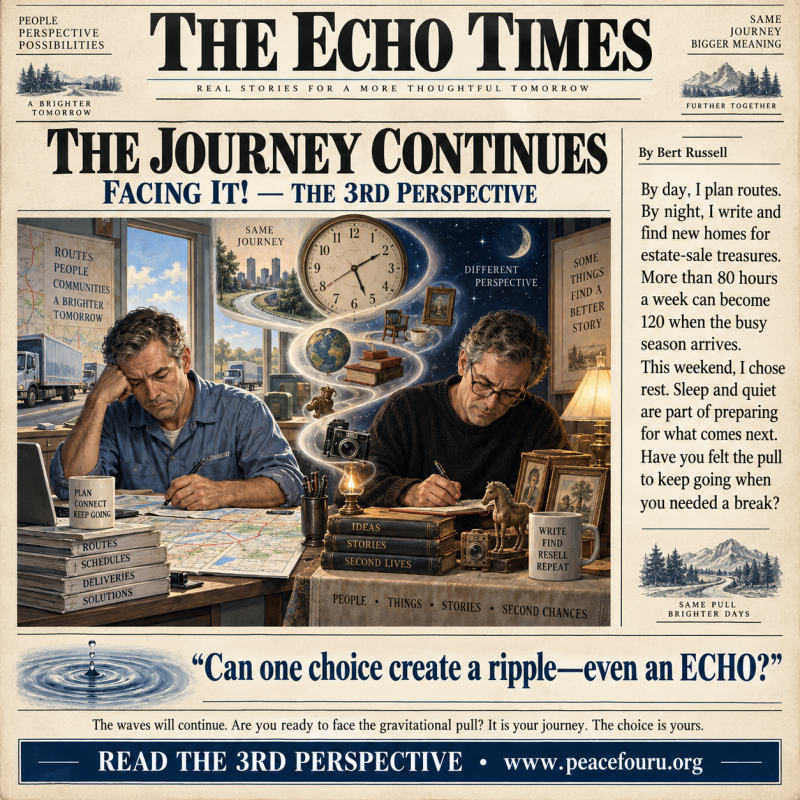
By day, I plan routes. By night, I write stories and find new homes for estate sale treasures. Together, those two lives can add up to more than 80 hours of work a week.
This week, I felt myself being pulled toward giving even more of my time and energy to work. I know a busy season is coming. Those 80 hours could become 120 if I keep saying yes, and I know myself well enough to know I probably would.
So this weekend, I said something I don’t say often: It’s time for a break.
I need sleep. I need quiet. I need time to relax before the next surge. Taking a break doesn’t mean I’ve lost my drive. It means I’m paying attention to what my mind and body are telling me.
Have you ever felt that pull to keep going when you knew you needed rest? What did you do?
FACING IT!
FORMER LAKE RATS
Can You Return to a Place Without Returning to Who You Were?
My wife and I recently took a chance.
We returned to Lake Lotawana to visit some former neighbors—people who once shared more than our address. They shared a chapter of our lives.
At first, we were both a little standoffish. Maybe we were protecting ourselves. Maybe we were unsure whether we still belonged there. Time had passed, lives had changed, and we were no longer the same people who once called the lake home.
Then something happened.
We relaxed.
We laughed.
We had a blast seeing everyone.
For a few hours, the distance created by time seemed to disappear. Old friendships resurfaced naturally, and memories returned faster than we could tell the stories behind them.
We realized how much we had missed those people—but we also realized how deeply we missed the peacefulness of lake life.
I can still remember driving slowly across the dam each day. I would look out over that wide, cove-like stretch of open water near Marina 27. There were only a few boat slips around the restaurant, but the view felt endless.
The menu was five-star. The meals were five-star. The drinks were expensive even back then—but people paid the price because the view came with them.
You were not only buying dinner.
You were buying a few hours beside the water.
You were buying the sound of waves gently touching the docks.
You were buying a sunset that did not need a filter.
You were buying peaceful silence.
Back then, I may not have understood how valuable that silence was. When peace surrounds you every day, it can begin to feel ordinary. You assume it will always be there.
Then life changes.
You move away. Responsibilities increase. Your thoughts grow louder. Your mindset shifts. The serenity you once carried becomes harder to find.
Returning to Lake Lotawana was wonderful—but it was also extremely confusing.
The lake was still there.
The houses still faced the water. Boats still rested beneath their covers. The sunset still stretched across the cove. Our former neighbors still knew how to laugh and welcome us back.
But something inside us was different.
We did not return with the same mindset we had when we lived there. The lake could remind us of peace, but it could not automatically restore it.
That is the truth I had to face.
Sometimes we believe returning to a place will return us to the person we were while living there. We expect the road, the water, the friendships, or the familiar view to unlock an earlier version of ourselves.
But a place can preserve our memories without preserving our state of mind.
Perhaps that is why the visit affected us so deeply. We were not only revisiting former neighbors. We were meeting former versions of ourselves—the Lake Rats who once lived closer to the water, closer to friendship, and maybe closer to peace.
We cannot move backward into that chapter.
But we can carry something forward from it.
We can slow down again.
We can reconnect with people before more years disappear.
We can seek peaceful moments without waiting until we live beside a lake.
We can remember that H2Olifestyles is not simply owning property near water. It is allowing the rhythm of the water to change how we move through life.
The lake did not give us back the serenity we once had.
It reminded us that we still miss it—and that perhaps we need to start rebuilding it within ourselves.
That is what Facing IT! means this time: admitting that we did not only leave the lake.
Somewhere along the way, we also drifted away from part of ourselves.
Now we know what we are searching for.
Can you return to a place from your past without expecting it to make you who you once were?
The storms eventually pass. ✌️
THE ECHO
FACING IT!
GOOD INTENTIONS DON'T LEAVE FOOTPRINTS
By Bert Russell
Friday, August 28, 2026
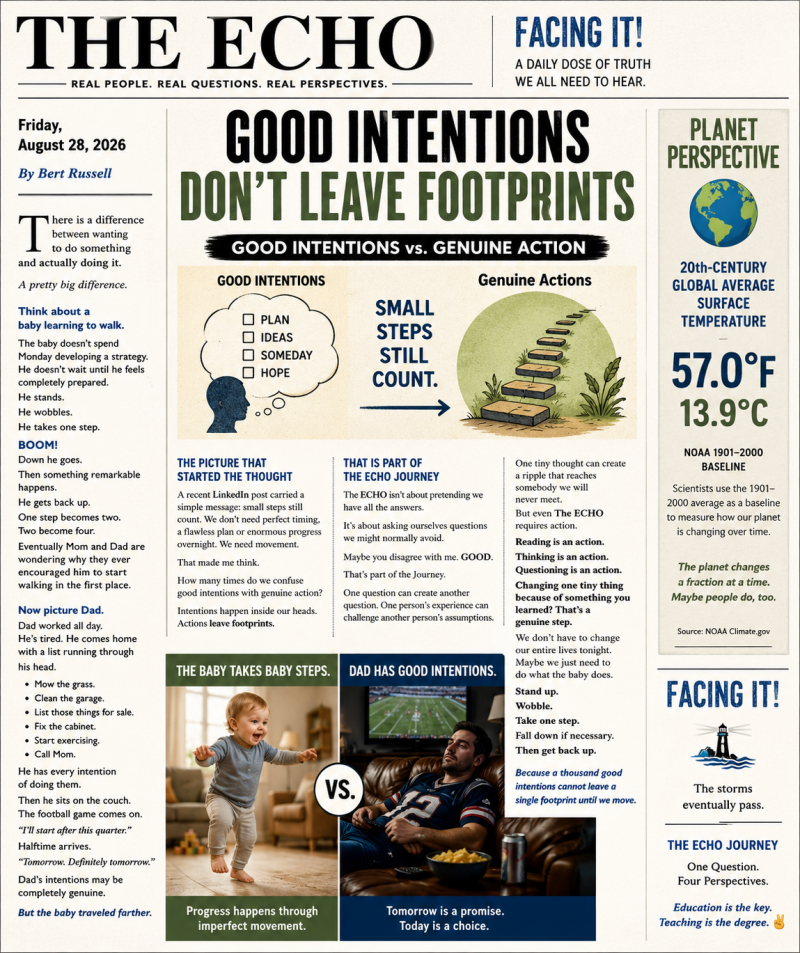
GOOD INTENTIONS vs. GENUINE ACTION
There is a difference between wanting to do something and actually doing it.
A pretty big difference.
Think about a baby learning to walk.
The baby doesn't spend Monday developing a strategy.
He doesn't wait until he feels completely prepared.
He stands.
He wobbles.
He takes one step.
BOOM!
Down he goes.
Then something remarkable happens.
He gets back up.
One step becomes two. Two become four. Eventually Mom and Dad are wondering why they ever encouraged him to start walking in the first place.
Now picture Dad.
Dad worked all day. He's tired. He comes home with a list running through his head.
Mow the grass. Clean the garage. List those things for sale. Fix the cabinet. Start exercising. Call Mom.
He has every intention of doing them.
Then he sits on the couch.
The football game comes on.
"I'll start after this quarter."
Halftime arrives.
"Tomorrow. Definitely tomorrow."
Dad's intentions may be completely genuine.
But the baby traveled farther.
THE PICTURE THAT STARTED THE THOUGHT
A recent LinkedIn post carried a simple message: small steps still count. We don't need perfect timing, a flawless plan or enormous progress overnight. We need movement.
That made me think.
How many times do we confuse good intentions with genuine action?
Intentions happen inside our heads.
Actions leave footprints.
- THAT IS PART OF THE ECHO JOURNEY
The ECHO isn't about pretending we have all the answers.
It's about asking ourselves questions we might normally avoid.
Maybe you disagree with me.
GOOD.
That's part of the Journey.
One question can create another question. One person's experience can challenge another person's assumptions. One tiny thought can create a ripple that reaches somebody we will never meet.
But even The ECHO requires action.
Reading is an action.
Thinking is an action.
Questioning is an action.
Changing one tiny thing because of something you learned?
That's a genuine step.
We don't have to change our entire lives tonight.
Maybe we just need to do what the baby does.
Stand up.
Wobble.
Take one step.
Fall down if necessary.
Then get back up.
Because a thousand good intentions cannot leave a single footprint until we move.
---
PLANET PERSPECTIVE
20th-Century Global Average Surface Temperature
57.0°F | 13.9°C
NOAA 1901–2000 baseline
The planet changes a fraction at a time.
Maybe people do, too.
---
FACING IT!
The storms eventually pass.
THE ECHO JOURNEY
One Question. Four Perspectives.
Education is the key. Teaching is the degree. ✌️
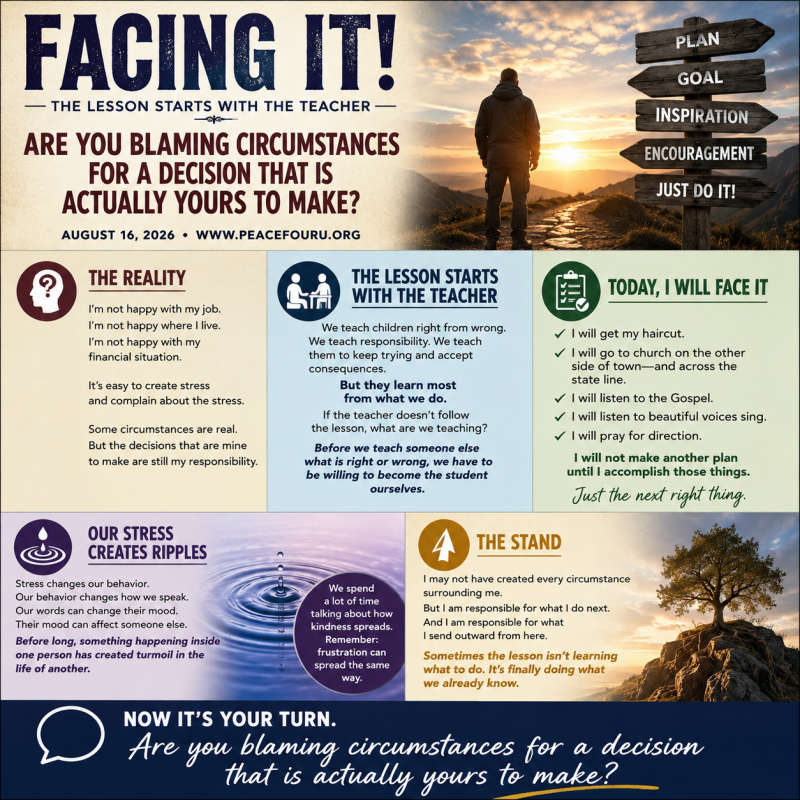
FACING IT!
THE LESSON STARTS WITH THE TEACHER
Are You Blaming Circumstances for a Decision That Is Actually Yours to Make?
August 16, 2026
www.PeaceFourU.org
I have been rolling around the idea of publishing my novel, memoir, fantasy—or whatever it is that I am writing.
I think about my job. Am I happy with my current position?
No.
Am I happy with where I live?
No.
Am I happy with my current financial situation?
No.
Those are uncomfortable answers.
But Facing IT! requires another question:
What have I actually done to change them?
That's where things become harder.
It is easy to create stress and then complain about the stress. It is easy to point toward circumstances, other people, money, work, timing, or a hundred other reasons why something hasn't changed.
Some of those circumstances are real.
But eventually, I have to separate the things I cannot control from the decisions that are still mine to make.
THE LESSON STARTS WITH THE TEACHER
Think about what we teach a child.
We teach them right from wrong. We tell them to accept responsibility. We encourage them to keep trying when something is difficult. We tell them that actions have consequences.
But children don't learn only from what we tell them.
They watch what we do.
If the teacher doesn't follow the lesson, what exactly are we teaching?
Maybe adulthood isn't that different.
I know I need a plan.
I know I need a goal.
I need inspiration. I need encouragement.
But eventually, I need to just do it.
And that doesn't mean I have to solve everything today.
TODAY, I WILL FACE IT
Today, I am going to get my haircut.
Then I am going to church on the other side of town—and across the state line.
I am going to listen to the Gospel.
I am going to listen to beautiful voices sing.
I am going to pray for direction.
And I am not making another plan until I accomplish those things.
No ten-step program.
No promises that tomorrow my entire life will suddenly be different.
Just the next right thing.
Because perhaps that's how change actually begins.
OUR STRESS CREATES RIPPLES
There is another reason this matters.
When we create drama around our own problems, it doesn't necessarily stay with us.
Stress changes our behavior.
Our behavior changes how we speak to someone.
Our words can change their mood.
Their mood can affect someone else.
Before long, something happening inside one person has created turmoil in the life of another.
That's a Ripple Effect, too.
We spend a lot of time talking about how kindness spreads.
We should remember that frustration can spread the same way.
So today, I am making a stand—not against the world, my employer, my finances, or anyone else.
I am making a stand with myself.
I may not have created every circumstance surrounding me.
But I am responsible for what I do next.
And I am responsible for what I send outward from here.
Maybe that's the lesson.
Before we teach someone else what is right or wrong, we have to be willing to become the student ourselves.
Sometimes the lesson isn't learning what to do.
Sometimes the lesson is finally doing what we already know.
Now it's your turn.
Are you blaming circumstances for a decision that is actually yours to make? ✌️
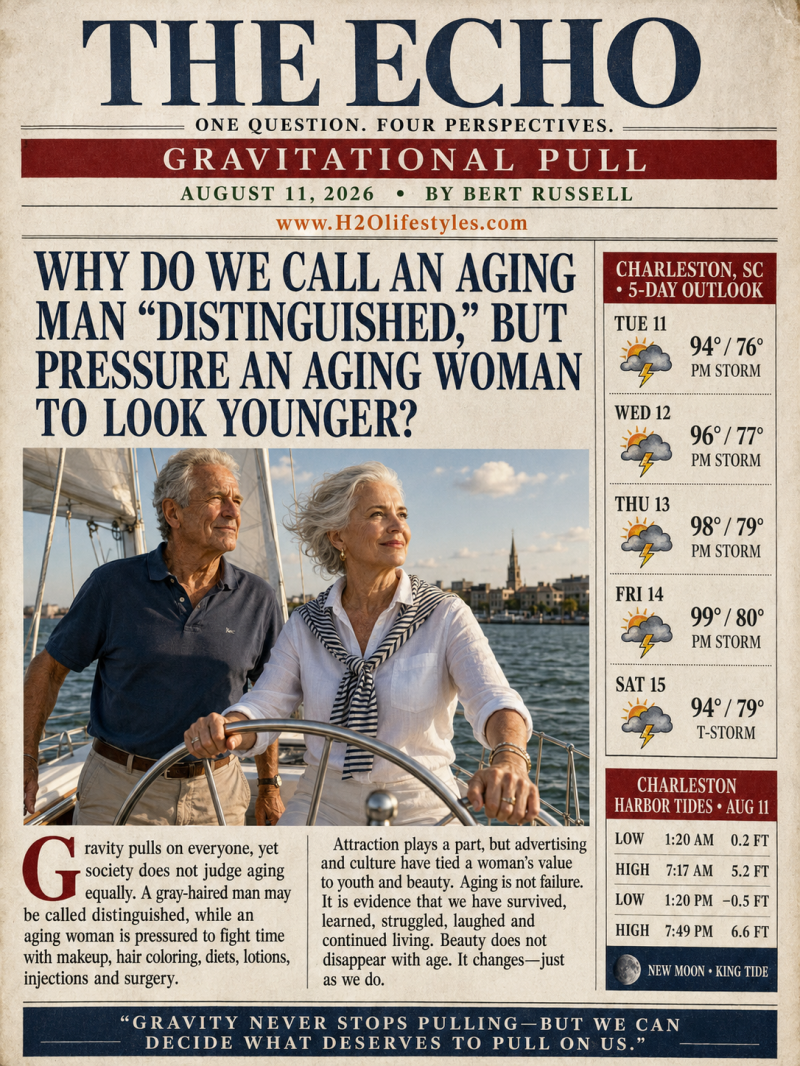
FACING IT! - The ECHO
WHEN DID I BECOME OKAY WITH WHO I AM—AND WHAT I LOOK LIKE?
August 11, 2026
www.PeaceFourU.org
As a man, I never thought much about my appearance.
Actually, I take that back.
From my early twenties through my late thirties, I cared—a little. I was single, playing the field, and wanted to look attractive. Once I got married, however, I stopped caring as much. I gained weight and paid less attention to my appearance.
I told myself I was simply comfortable.
But was I comfortable—or had I become careless?
Sometime between the ages of forty and forty-five, I developed diabetes. At first, I did not believe it. I did not want to face what my body was telling me.
Then I lost something extremely important to me: my sight.
That changed everything.
I finally began caring for myself—not to impress strangers and not to win anyone’s approval. I started caring because my health, my life, and my ability to see were worth protecting.
Health problems can completely change a person’s mindset. Sometimes we do not appreciate what our bodies provide until something begins slipping away.
My wife tells me she still finds me attractive. Could she be lying?
YES!
And I am perfectly fine with that.
I am no longer trying to impress the entire world. If my appearance benefits anyone besides myself, I want it to be the woman who chose to share her life with me.
But taking care of myself is no longer about whether she—or anyone else—likes what they see.
It is about liking myself enough to protect what I still have.
That is the truth I finally had to face.
WHAT IS YOUR TRUTH?
Peace ✌️